Traductor

28 March 2012

Air Pollution from Trucks and Low-Quality Heating Oil May Explain Childhood Asthma Hot Spots


Results appear online in the Journal of Exposure Science and Environmental Epidemiology.
In New York City, where the study was conducted, asthma among school-age children ranges from a low of 3% to a high of 19% depending on the neighborhood, and even children growing up within walking distance of each other can have 2- to 3-fold differences in risk for asthma. Helping explain these disparities, the researchers found that levels of airborne black carbon, which mostly comes from incomplete combustion sources like diesel trucks and oil furnaces, were high in homes of children with asthma. They also reported elevated levels of black carbon within homes in neighborhoods with high asthma prevalence and high densities of truck routes and homes burning low-grade or "dirty" heating oil.
"This study adds to the evidence that further public health interventions on oil and truck emissions standards and the use of dirty oil may be warranted. This is especially timely as New York City considers regulations to further reduce the burning of low-grade oil for domestic heating," says the study's senior author, Matthew Perzanowski, PhD, associate professor of Environmental Health Sciences.
The study may be the first to show an association between airborne black carbon in the home and proximity to buildings burning dirty oil (low-grade, types 4 and 6). "Because of its history as a shipping and oil refining center, New York City burns more dirty oil for residential and commercial heating than any other city in the country," says study co-author Steven Chillrud, PhD, Lamont Research Professor at Columbia's Lamont-Doherty Earth Observatory . "These fuels produce more byproducts of incomplete combustion than cleaner oil or natural gas and contribute substantially to air pollution. Buildings that burn dirty oil are unevenly distributed throughout the city, which could help explain disparities in health."
The research team collected air samples from inside the homes of 240 7- and 8-year-old children from middle-income neighborhoods throughout New York City. These children also took breathing tests to measure exhaled nitric oxide, an indicator of lung inflammation.
"Airway inflammation plays an important role in the development of asthma and can contribute to more frequent symptoms among children with the disease," says study lead author Alexandra Cornell, MD, assistant professor in pediatrics at Dartmouth Medical School and previously a pediatric pulmonology fellow at Columbia University Medical Center/NewYork-Presbyterian Hospital. "Children in this study with higher black carbon in the air of their homes had higher exhaled nitric oxide, suggesting that they were at greater risk for asthma exacerbations. That this increased risk comes from air pollution lends weight to New York City's efforts to improve air quality, including phasing out the use of dirty oil, which is a large contributor to local air pollution. "

**Published in "SCIENCE DAILY"

Europa, a la cabeza del consumo de alcohol según un informe


Los europeos consumen más alcohol que los ciudadanos de ninguna otra parte del mundo. En concreto, el equivalente a 12 litros y medio de alcohol puro por adulto al año o tres bebidas al día. Así lo refleja un informe de la Organización Mundial de la Salud (OMS) copatrocinado por la Comisión Europea, que revela que Europa tiene el "dudoso honor" de duplicar en 15 años el consumo medio de alcohol en el mundo.
"El dudoso honor europeo de haber duplicado la media global de consumo de alcohol está claro, con conocidas consecuencias sanitarias para los bebedores, las personas que les rodean y la sociedad en general", señala la directora regional para Europa de la OMS, Zsuzsanna Jakab, para quien el mensaje de este informe es que "la carga de enfermedad relacionada con el alcohol en Europa es evitable".
Según este documento, las variaciones sociales, culturales, geográficas y económicas entre los diferentes países de la UE han llevado a distinguir cuatro grupos: este y centro-este de Europa, centro-oeste y oeste de Europa, los países nórdicos y el sur de Europa, con diferentes consumos, patrones y tendencias.
Esta diferencia revela que el mayor consumo de alcohol se realiza en el este y centro-este de Europa, con 14 litros y medio de alcohol puro por adulto al año, en comparación con los casi 12 litros y medio del centro-oeste y oeste de Europa; los 11,2 litros del sur de Europa y los casi 10 litros y medio de los nórdicos.
Cuando se tienen en cuenta los indicadores de consumo peligroso de alcohol -la proporción de bebida que se toma fuera de las comidas, en lugares públicos o el consumo por atracones ('binge drinking')- el este y centro-este de Europa alcanza la mayor puntuación, 2,9 en una escala que va desde el 1 como el registro de menor daño hasta el 5 como la puntuación que señala el consumo más dañino. Le siguen países nórdicos (2,8); el centro-oeste y oeste europeo (1,5) y sur de Europa (1,1).

El este y los países nórdicos aumentan su consumo

Aunque el consumo europeo del alcohol per cápita se ha mantenido casi constante durante la pasada década, a nivel subregional los países nórdicos y el este de Europa han experimentando un incremento del consumo de alcohol entre los adultos, mientras que ha bajado en el oeste y el sur del continente.
Según este informe, las tasas de mortalidad asociadas al alcohol fueron de 57 por cada 100.000 para los hombres y de 15 por cada 100.000 para mujeres en 2004. También las tasas subregionales de mortalidad varían ampliamente, desde los 129 hombres y 27 mujeres por cada 100.000 en centro-este y este de Europa, hasta las tasas más bajas de 30 hombre y 10 mujeres en el sur de Europa.
Además de estas diferencias generales, las tendencias subregionales específicas influyen en las causas de estas muertes. Así, son más las muertes en centro-este y este de Europa causadas por enfermedades cardiovasculares -excepto la enfermedad cardiaca isquémica- y las heridas. Esto está relacionado con la gran cantidad de alcohol que se consume en estos países y la irregulares sesiones de gran consumo.
En los países nórdicos son proporcionalmente más frecuentes los fallecimientos por desórdenes neurológicos y mentales, debido a la alta prevalencia de alcoholismo y desórdenes relacionados con el consumo de este producto. Por su parte, el cáncer es, proporcionalmente, más frecuente en el sur de Europa, donde los niveles de consumo era considerablemente más alto hace dos décadas y el cáncer necesita tiempo suficiente para desarrollarse.

Daños a terceros

Además de provocar daños a uno mismo, el consumo de alcohol afecta a otras personas. Según una revisión de datos de 2004, unas 5.500 muertes de hombres de todas las edades en la UE y de 2.000 muertes de mujeres podrían atribuirse al consumo de alcohol de otros, siendo las principales causas de fallecimientos y heridas los accidentes de tráfico, seguidos por la violencia como segunda causa.
Por su parte, el sur de Europa muestra la mayor proporción de consumidores de alcohol que perjudican a otros ciudadanos, en comparación al daño total relacionado con el alcohol que se registra en esta subregión medido por muertes. Sin embargo, en centro-este y este de Europa los cálculos revelan la mayor proporción de accidentes con vehículos de motor atribuibles al consumo de alcohol.
Este informe, titulado 'Alcohol en la UE', apunta una serie de políticas coste-efectivas de éxito probado para reducir estas tasas, entre ellas el aumento de los impuestos sobre el alcohol, la reducción de la disponibilidad y las restricciones en su venta.

*AGENCIAS

Single antibody shrinks variety of human tumors transplanted into mice, Stanford study shows


Human tumors transplanted into laboratory mice disappeared or shrank when scientists treated the animals with a single antibody, according to a new study from the Stanford University School of Medicine. The antibody works by masking a protein flag on cancer cells that protects them from macrophages and other cells in the immune system. The scientists achieved the findings with human breast, ovarian, colon, bladder, brain, liver and prostate cancer samples. It is the first antibody treatment shown to be broadly effective against a variety of human solid tumors, and the dramatic response -- including some overt cures in the laboratory animals -- has the investigators eager to begin phase-1 and -2 human clinical trials within the next two years.
"Blocking this 'don't-eat-me' signal inhibits the growth in mice of nearly every human cancer we tested, with minimal toxicity," said professor of pathology Irving Weissman, MD, who directs Stanford's Institute of Stem Cell Biology and Regenerative Medicine and the Ludwig Center for Cancer Stem Cell Research and Medicine at Stanford. "This shows conclusively that this protein, CD47, is a legitimate and promising target for human cancer therapy."
The antibody treatment also significantly inhibited the ability of the tumors to metastasize throughout the animals' bodies.
"This is exciting work and will surely trigger a worldwide wave of research designed to convert this strategy into useful therapies," said Robert Weinberg, PhD, a professor of biology at the Whitehead Institute for Biomedical Research in Massachusetts who was not involved in the research. "Mobilizing the immune system to attack solid tumors has been a longstanding goal of many cancer researchers for decades."
The research was published online March 26 in the Proceedings of the National Academy of Sciences. Weissman, who is the Virginia & D.K. Ludwig Professor for Clinical Investigation in Cancer Research at Stanford and a member of the Stanford Cancer Institute, is the senior author of the research. Postdoctoral scholars Stephen Willingham, PhD, and Jens-Peter Volkmer, MD, are the co-first authors of the study.
Previous work in Weissman's lab has shown that CD47 is normally expressed on the surfaces of circulating blood stem cells to protect them from immune cells called macrophages. Macrophages patrol the body looking for signs of trouble in the form of invaders or rogue cells, but they sometimes latch onto the wrong targets. CD47 prompts them to release cells they've grabbed by mistake.
Weissman and his colleagues also showed previously that some types of cancer cells -- particularly those of blood cancers such as leukemia and lymphoma -- have figured out a way to game the system and use this "don't-eat-me signal" to their advantage by expressing CD47 on their own surfaces. In 2010, they found that blocking CD47 with a specific antibody (plus adding another to further stimulate the macrophages' killing instinct) can cure some cases of human non-Hodgkin's lymphoma in mice. But it wasn't known until now how widespread or clinically important the phenomenon would be in human solid tumors.
In the current study, Willingham and Volkmer collected surgical samples of a variety of human tumors, including ovarian, breast, colon, bladder, brain, liver and prostate. To do so, they enlisted the help of clinical experts from across the School of Medicine, including those specializing in oncology, urology, obstetrics and gynecology, radiation oncology, neurosurgery, hematology, pathology, otolaryngology and hepatology.
They showed that nearly every human cancer cell they examined expressed CD47 -- usually at higher levels (on average, about three times more) than did non-cancerous cells. Furthermore, people whose cancer cells express a lot of CD47 tend to have shorter life spans than people with similar cancers that express less CD47. This suggests that an analysis of the levels of CD47 expression in some types of tumors could be a valuable prognostic tool for patients and their doctors.
Willingham and Volkmer then implanted the different human tumor cells into matching locations in the bodies of mice -- breast cancer tumors into the mammary fat pads, and ovarian cancer tumors into the abdomen, for example. Once the tumors were well-established (after two weeks or more), they treated the animals with the anti-CD47 antibody.
The researchers saw that most of the established tumors begin to shrink and even, in some cases, disappear within weeks of treatment with the antibody. In one case, antibody treatment cured five mice injected with the same human breast cancer cells. When the tumor was gone, the treatment was discontinued; the mice were monitored for four months with no signs of recurrence.
"These results indicate that anti-CD47 antibodies can dramatically inhibit the growth of human solid tumors by blocking the ability of CD47 to transmit the 'don't-eat-me' signal to macrophages," concluded the authors.
"If the tumor was highly aggressive," said Weissman, "the antibody also blocked metastasis. It's becoming very clear that, in order for a cancer to survive in the body, it has to find some way to evade the cells of the innate immune system." The innate immune system is the body's first line of defense against pathogens like bacteria and viruses. Unlike the adaptive immunity conferred by antibodies and T cells that recognize and battle specific molecules, cells of the innate immune system, like macrophages, respond non-specifically to a variety of threats.
The researchers' approach didn't work in every animal, though. A set of mice with breast cancer cells from a one human patient experienced no benefit from antibody treatment. "There's certainly more to learn," said Weissman. "We need to learn more about the relationship between macrophages and tumor cells, and how to draw more macrophages to the tumors." He suggested that reducing the size of a tumor with surgery or radiotherapy before antibody treatment could make the treatment more effective. Another option, he added, would be to use a second antibody in addition to CD47 that would further stimulate the ability of the macrophages or other immune cells to kill the cancer cells.
While treatment modifications may be beneficial, the findings about the effect of the single antibody are promising in their own right and set the stage for advancing the research. "We believe these results show that we should move forward quickly but cautiously into human clinical trials for many types of solid tumors," Weissman said.

**Source: Stanford University Medical Center

Nanopartículas para la medicina del futuro


En la actualidad, la investigación en nanopartículas es un área de gran interés debido a la inmensa variedad de aplicaciones potenciales. Hoy tengo la fortuna de poder charlar con Luis M. Liz Marzán , catedrático en la Universidad de Vigo y uno de los científicos españoles de mayor prestigio internacional, pionero mundial en el estudio de la síntesis, caracterización y aplicaciones de las nanopartículas metálicas. Entre otros, su trabajo está permitiendo el desarrollo de nuevas terapias médicas y nuevos sensores ultra sensibles, capaces de detectar enfermedades en sus estados iniciales o conocer la presencia de productos tóxicos con muy baja concentración.
Mónica Luna.- ¿De dónde emana la fascinación científica actual por las nanopartículas? Luis Liz.- Del hecho de que sus propiedades no sólo dependen de su composición, tal y como nos dice nuestra experiencia, sino también de su tamaño y su forma. Esto nos abre un abanico inmenso de posibilidades. Por ejemplo, el oro siempre tiene un color dorado, a no ser que reduzcas tanto sus dimensiones que comiences a tener trozos del tamaño de decenas de nanómetros. Entonces el oro empieza a tener un color azul que se torna rojizo a medida que disminuyes aún más el tamaño de sus nanopartículas . Igualmente, su color también varía modificando levemente la forma de la nanopartícula.
Luis Liz Marzán Luis Liz Marzán
Otro ejemplo interesante de propiedad que cambia con las diferentes formas geométricas es la distribución del campo eléctrico, como se puede observar en la imagen inferior. Por ejemplo, en el caso de una nanopartícula triangular, las zonas en las que el campo eléctrico es más intenso (color rojo) son los vértices.
El campo eléctrico se amplifica en distintas zonas para cada tipo de nanopartícula. Liz Marzán
M. L.- ¿Qué propiedades de las nanopartículas consideran especialmente interesantes en su investigación?
L. L.- Esta propiedad que acabo de mencionar: cómo se concentra el campo eléctrico en las distintas zonas de las nanopartículas, es especialmente relevante a la hora de utilizar las nanopartículas como sensores de alta sensibilidad, capaces de detectar incluso la presencia de una sola molécula. Aprovechando la concentración del campo eléctrico en zonas específicas de las nanopartículas, conseguimos amplificar las señales luminosas que proceden de las moléculas unidas a ellas y de esta forma aumentar la sensibilidad de su detección.
M. L.- ¿Nos podría poner un ejemplo de esta forma de detección de moléculas?
Nanopartículas con diferentes geometrías. | L. Liz Marzán Nanopartículas con diferentes geometrías. | L. Liz Marzán
L. L.- Un tipo de nanopartícula especialmente conveniente para detectar la presencia de una sola molécula son las nanoestrellas. En la imagen inferior se puede ver, en blanco y negro, una imagen por microscopía electrónica de una nanoestrella real con un tamaño de unos 50 nanómetros. El resto de la imagen (en color) es un esquema de cómo funciona la detección. Estas nanoestrellas concentran muy bien el campo eléctrico en sus puntas. El primer paso consiste en unir químicamente una nanoestrella a la molécula que queremos detectar (en el esquema, molécula de color blanco). Al utilizar métodos ópticos de detección de moléculas, es decir, métodos en los que cada tipo de molécula emite una luz particular (como si fuera una huella dactilar de la molécula), nos encontramos que, gracias a la utilización de nanoestrellas, la luz que emite se amplifica mucho. De esta forma, podemos detectar su presencia aunque la cantidad de moléculas (de color blanco) sea muy baja.
El campo eléctrico se amplifica en distintas zonas para cada tipo de nanopartícula.| Liz Marzán El campo eléctrico se amplifica en distintas zonas para cada tipo de nanopartícula.| Liz Marzán
M. L.- ¿Cuáles son las ventajas de poder disponer de detectores moleculares tan sensibles?
L. L.- Muchas e importantes. Se podrían detectar enfermedades en sus comienzos, cuando aún no hay síntomas. Aunque la enfermedad esté en sus inicios y haya muy baja concentración de las moléculas indicadoras en la sangre, con métodos más sensibles se podría diagnosticar las enfermedades en etapas tempranas.
Por ejemplo, el principal obstáculo con el que los científicos se encuentran a la hora de diagnosticar la enfermedad de las vacas locas es la imposibilidad de distinguir entre el prión funcional que tienen todas las personas y animales y el infeccioso que causa la patología. Estas proteínas apenas emiten señales ópticas, con lo que también resulta imposible detectarlas. Nosotros hemos introducido nanopartículas de oro que amplifican en miles de millones de veces la señal de la molécula defectuosa, con lo cual se pueden observar incluso en concentraciones muy bajas. El sensor es capaz de detectar la presencia de hasta diez priones por cada litro de sangre, que luego, a través de un análisis por espectrofotometría, permite desvelar si son infecciosos o normales.
En humanos, enfermedades como el Alzheimer y el Parkinson también podrían detectarse de forma temprana por compartir origen priónico.
M. L.- ¿Están investigando alguna aplicación de las nanopartículas relacionadas con terapia médica?
L. L.- Estamos estudiando varias posibles aplicaciones. Una de ellas consiste en utilizar las nanopartículas como repartidoras de fármacos. Como se muestra en el vídeo de la portada, cuando la nanopartícula se hidrata, aumenta de tamaño y el fármaco se infiltra en su interior. Cuando se comprime, el fármaco queda atrapado y puede ser liberado por señales térmicas o por cambios de acidez.
Otro tema de investigación que actualmente estamos llevando a cabo gracias a una importante financiación europea consiste en entender cómo se comunican las bacterias y cómo detectan la presencia de otras células. Nos gustaría llegar a conocer cómo podemos manipular el comportamiento de las bacterias para que, en presencia ciertos tejidos, actúen de modo menos agresivo y así poder prevenir enfermedades. Asimismo, buscamos poder manipular estas bacterias con la finalidad de que se comporten de modo más o menos activo con ciertos tipos de células, algo que podría utilizarse como sistemas de terapia.
M. L.- ¿Cree que si los resultados de su investigación llegasen a establecerse como terapias, serían seguras?
L. L.- Los protocolos de seguridad a los que están obligados los medicamentos y terapias médicas son muy estrictos. Si consiguen pasarlos podemos estar seguros de que no habrá contraindicaciones graves.
M. L.- ¿Cuál es la parte más importante de la investigación que realizan?
L. L.- Creo que la parte relacionada con ciencia básica es muy importante. Es imprescindible entender cómo crecen las partículas, porqué crecen con unas determinadas condiciones y porqué eso da lugar a unas propiedades específicas. Investigar en ciencia básica es fundamental para conocer qué pueden hacer las nanopartículas, tanto para bien, como para mal. Además, para poder llegar a aplicaciones prácticas hay que entender los aspectos básicos y por eso hay que invertir esfuerzo en proyectos que aparentemente no llegan a una aplicación directa.
Mónica Luna es investigadora en Nanociencia y Nanotecnología en el Instituto de Microelectrónica de Madrid (CNM-CSIC).
monica.luna.estevez@gmail.com


**publicado en "EL MUNDO"

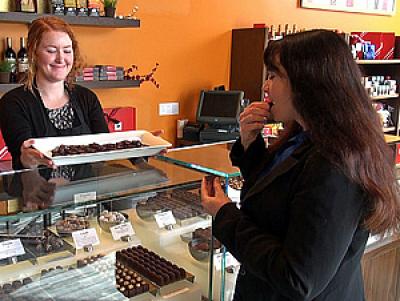
Regular chocolate eaters are thinner


This is Beatrice Golomb, M.D, Ph.D. (right).
UC San Diego School of Medicine

Katherine Hepburn famously said of her slim physique: "What you see before you is the result of a lifetime of chocolate." New evidence suggests she may have been right. Beatrice Golomb, MD, PhD, associate professor in the Department of Medicine at the University of California, San Diego, and colleagues present new findings that may overturn the major objection to regular chocolate consumption: that it makes people fat. The study, showing that adults who eat chocolate on a regular basis are actually thinner that those who don't, will be published online in the Archives of Internal Medicine on March 26.
The authors dared to hypothesize that modest, regular chocolate consumption might be calorie-neutral -in other words, that the metabolic benefits of eating modest amounts of chocolate might lead to reduced fat deposition per calorie and approximately offset the added calories (thus rendering frequent, though modest, chocolate consumption neutral with regard to weight). To assess this hypothesis, the researchers examined dietary and other information provided by approximately 1000 adult men and women from San Diego, for whom weight and height had been measured.
The UC San Diego findings were even more favorable than the researchers conjectured. They found that adults who ate chocolate on more days a week were actually thinner -- i.e. had a lower body mass index -- than those who ate chocolate less often. The size of the effect was modest but the effect was "significant" -larger than could be explained by chance. This was despite the fact that those who ate chocolate more often did not eat fewer calories (they ate more), nor did they exercise more. Indeed, no differences in behaviors were identified that might explain the finding as a difference in calories taken in versus calories expended.
"Our findings appear to add to a body of information suggesting that the composition of calories, not just the number of them, matters for determining their ultimate impact on weight," said Golomb. "In the case of chocolate, this is good news -both for those who have a regular chocolate habit, and those who may wish to start one."

*Source: University of California, San Diego Health Sciences

El 7% de la población padece tos crónica


La tos crónica es aquella tos que persiste más allá de 8 semanas.
Molesta, irritante, discapacitante, etc. Son muchos los adjetivos que se le pueden poner a la tos crónica, una situación que no es una enfermedad en sí misma, pero que puede afectar profundamente la calidad de vida de una persona.

Se entiende por tos crónica como aquella «tos que persiste más allá de 8 semanas», explica Adalberto Pacheco Galván, de la Unidad de Asma y Tos Crónica, del Hospital Ramón y Cajal (Madrid). Aunque su incidencia está poco analizada, se calcula que en Europa, el 7% de la población adulta sufre tos crónica no ligada «a radiografía de tórax patológica ni a enfermedad pulmonar obstructiva crónica (EPOC)».

El problema, dice este experto, es que muchos pacientes se «adaptan» al problema que creen que es por un «mal catarro» por el humo del tabaco, o la contaminación de las ciudades. Esto es lo que le pasó a M. José Avellanada quien, desde que tiene memoria, recuerda tener tos. «A los 4 años tuve la tos ferina y desde entonces no he dejado de toser hasta 2009».
Siempre con tos
Cuando M. José habla de su vida siempre aparece la tos. «A mi en casa me decían ¿cómo es posible que estés toda la noche tosiendo?, pero yo no era consciente de ello. Lo cierto es que me levantaba hecha polvo, como si no hubiera dormido nada».
El problema es, asegura Pacheco, que «más de la mitad de tosedores crónicos permanecen sin diagnóstico y en un altísimo porcentaje van de especialista en especialista sin lograr solucionar su problema porque, la tos crónica, es un asunto multidisciplinar que abarca varias especialidades como otorrinolaringología, alergia, digestivo y neumología. Por eso -subraya- es preciso la existencia de Unidades de Tos Crónica donde se pueda aglutinar la información procedente de diversos orígenes y alcanzar así tasas de éxitos cercanas al 90%».
5 cosas que hay que saber sobre la tos crónica
1. ¿Es una enfermedad o consecuencia de otras?
No es una enfermedad, es un síntoma que puede ser más o menos predominante entre otros síntomas, y así, hay enfermedades donde la tos es un síntoma más como en la EPOC o el cáncer o la fibrosis pulmonar y otros, donde es el síntoma más importante como en el asma tipo tos o la enfermedad de vía aérea superior como la sinusitis-rinitis , o en el reflujo gastroesofágico o en la tos de origen en laringe. La tos es un «avisador» de que algo no funciona bien, y además, en vez de ser un mecanismo de defensa que todos debemos tener se convierte en algo molesto, y puede dar lugar a depresiones, o también síncopes por reducción del oxígeno cerebral en los golpes de tos, o incontinencia urinaria en las mujeres o incluso fractura de costillas tras golpes de tos.


2. ¿Quién debe diagnosticarla y tratarla?
Primero hay que descartar que la tos crónica avise de una enfermedad importante. Posteriormente, es preciso hacer una historia de fármacos porque algunos antihipertensivos pueden desencadenar tos crónica. Una vez hecha una radiografía de tórax y una espirometría, se debe llevar a cabo un estudio multidisciplinar.

3. ¿Cómo se debe tratar?
Hay que tratar todas las causas potenciales de tos crónica, de origen en tráquea- bronquio, esófago, sinusitis-rinitis y área de laringe con medicaciones especificas dirigidas a cada órgano o sistema requiriéndose a veces dos o mas tratamientos distintos para obtener un resultado óptimo. Si no se hace se convierte en un problema molesto o incluso se acepta por el paciente como «algo natural».
4. ¿Cuales son las comorbilidades más frecuentes?
El tosedor crónico suele ser portador de picor laríngeo, cosquilleos, carraspera, regurgitaciones frecuentes, ardores, pitos al respirar, rinitis frecuentes con secreciones transparentes y estornudos, depresiones y ansiedad, dolor de garganta etc.

5. ¿Cuál es la situación en España en cuanto a su manejo?
Mala, porque no existen Unidades Especializadas en Tos Crónica como ocurre en el norte de Europa o EE.UU., y cada especialista trata la tos en su ámbito produciéndose múltiples fracasos terapéuticos.

**Publicado en "ABC SALUD"

University of Maryland completes most extensive full face transplant to date


The University of Maryland released details today of the most extensive full face transplant completed to date, including both jaws, teeth, and tongue. The 36-hour operation occurred on March 19-20, 2012 at the R Adams Cowley Shock Trauma Center at the University of Maryland Medical Center and involved a multi-disciplinary team of faculty physicians from the University of Maryland School of Medicine and a team of over 150 nurses and professional staff. The face transplant, formally called a vascularized composite allograft (VCA), was part of a 72-hour marathon of transplant activity at one of the busiest transplant centers in the world. The family of one anonymous donor generously donated his face and also saved five other lives through the heroic gift of organ donation. Four of these transplants took place over the course of two days at the University of Maryland Medical Center.
The face transplant team was led by Eduardo D. Rodriguez, M.D., D.D.S., associate professor of surgery at the University of Maryland School of Medicine and chief of plastic, reconstructive and maxillofacial surgery at the R Adams Cowley Shock Trauma Center at the University of Maryland Medical Center. Dr. Rodriguez is board-certified in plastic and reconstructive surgery as well as in oral and maxillofacial surgery. This marks the first time in the world that a full face transplant was performed by a team of plastic and reconstructive surgeons with specialized training and expertise in craniofacial surgery and reconstructive microsurgery.
"We utilized innovative surgical practices and computerized techniques to precisely transplant the mid-face, maxilla and mandible including teeth, and a portion of the tongue. In addition, the transplant included all facial soft tissue from the scalp to the neck, including the underlying muscles to enable facial expression, and sensory and motor nerves to restore feeling and function," explains Dr. Rodriquez. "Our goal is to restore function as well as have aesthetically pleasing results."
The face transplant recipient, 37-year-old Richard Lee Norris of Hillsville, Virginia, was injured in 1997 in a gun accident. Since that time, he has undergone multiple life-saving and reconstructive surgeries. Due to the accident, Mr. Norris lost his lips and nose and had limited movement of his mouth. Mr. Norris first came to the University of Maryland Medical Center in 2005 to discuss reconstructive options with Dr. Rodriguez.
Grant funding from the Office of Naval Research (ONR) in the Department of Defense to Dr. Stephen Bartlett has supported the University of Maryland basic and clinical research program in vascularized composite transplantation leading up to and supporting this groundbreaking face transplant. The ONR funds medical research to support military operational medicine and clinical care of returning veterans. In addition to conducting research, the University of Maryland supports military medicine in a variety of ways, including training military medical staff prior to deployment and performing organ transplant surgeries for patients at Walter Reed/Bethesda National Naval Medical Center.
"The future of medicine depends on rapid translation of research and creating high-performing teams. The face transplant is a perfect example of the life-changing options we can provide for our patients when we combine the expertise of our research and clinical teams to pursue procedures that would have seemed unfathomable not so long ago," says E. Albert Reece, M.D., Ph.D., M.B.A., vice president of medical affairs at the University of Maryland and dean of the University of Maryland School of Medicine.
The team of face transplant surgeons benefited greatly from their experience treating high-velocity ballistic facial injuries at the R Adams Cowley Shock Trauma Center at the University of Maryland Medical Center. The team also includes research scientists and physician scientists from the University of Maryland's nationally recognized Division of Transplantation who have been researching ways to reduce rejection of donated organs and minimize the side effects of long-term immunosuppressive use after transplantation.
"A project like the face transplant requires multi-disciplinary collaboration between numerous clinical services and in many ways is very similar to trauma care," says Thomas M. Scalea, M.D., Francis X. Kelly Professor of Trauma Surgery, director, Program in Trauma, University of Maryland School of Medicine, and physician-in-chief, R Adams Cowley Shock Trauma Center. "Because we have an infrastructure built around multi-disciplinary care, it made sense for the facial transplant program to be housed at the Shock Trauma Center in the University of Maryland Medical Center."

**Source: University of Maryland Medical Center

CONTACTO · Aviso Legal · Política de Privacidad · Política de Cookies

Copyright © Noticia de Salud