Traductor

29 March 2012

Meditation Improves Emotional Behaviors in Teachers


 Schoolteachers who underwent a short but intensive program of meditation were less depressed, anxious or stressed -- and more compassionate and aware of others' feelings, according to a UCSF-led study that blended ancient meditation practices with the most current scientific methods for regulating emotions.

A core feature of many religions, meditation is practiced by tens of millions around the world as part of their spiritual beliefs as well as to alleviate psychological problems, improve self-awareness and to clear the mind. Previous research has linked meditation to positive changes in blood pressure, metabolism and pain, but less is known about the specific emotional changes that result from the practice.
The new study was designed to create new techniques to reduce destructive emotions while improving social and emotional behavior.
The study will be published in the April issue of the journal Emotion.
"The findings suggest that increased awareness of mental processes can influence emotional behavior," said lead author Margaret Kemeny, PhD, director of the Health Psychology Program in UCSF's Department of Psychiatry. "The study is particularly important because opportunities for reflection and contemplation seem to be fading in our fast-paced, technology-driven culture."
Altogether, 82 female schoolteachers between the ages of 25 and 60 participated in the project. Teachers were chosen because their work is stressful and because the meditation skills they learned could be immediately useful to their daily lives, possibly trickling down to benefit their students.
Study Arose After Meeting Dalai Lama
The study arose from a meeting in 2000 between Buddhist scholars, behavioral scientists and emotion experts at the home of the Dalai Lama. There, the Dalai Lama and Paul Ekman, PhD, a UCSF emeritus professor and world expert in emotions, pondered the topic of emotions, leading the Dalai Lama to pose a question: In the modern world, would a secular version of Buddhist contemplation reduce harmful emotions?
From that, Ekman and Buddhist scholar Alan Wallace developed a 42-hour, eight-week training program, integrating secular meditation practices with techniques learned from the scientific study of emotion. It incorporated three categories of meditative practice:
  • Concentration practices involving sustained, focused attention on a specific mental or sensory experience;
  • Mindfulness practices involving the close examination of one's body and feelings;
  • Directive practices designed to promote empathy and compassion toward others.
In the randomized, controlled trial, the schoolteachers learned to better understand the relationship between emotion and cognition, and to better recognize emotions in others and their own emotional patterns so they could better resolve difficult problems in their relationships. All the teachers were new to meditation and all were involved in an intimate relationship.
"We wanted to test whether the intervention affected both personal well-being as well as behavior that would affect the well-being of their intimate partners," said Kemeny.
As a test, the teachers and their partners underwent a "marital interaction" task measuring minute changes in facial expression while they attempted to resolve a problem in their relationship. In this type of encounter, those who express certain negative facial expressions are more likely to divorce, research has shown.
Some of the teachers' key facial movements during the marital interaction task changed, particularly hostile looks which diminished. In addition, depressed mood levels dropped by more than half. In a follow-up assessment five months later, many of the positive changes remained, the authors said.
"We know much less about longer-term changes that occur as a result of meditation, particularly once the 'glow' of the experience wears off," Kemeny said. "It's important to know what they are because these changes probably play an important role in the longer-term effects of meditation on mental and physical health symptoms and conditions."

**Published in "SCIENCE DAILY"

Miles de enfermos de cáncer por amianto serán indemnizados en Gran Bretaña


Miles de trabajadores que han contraído cáncer por haber estado expuestos a amianto deberán ser indemnizados, según una histórica sentencia del Tribunal Supremo británico. Los jueces han dictaminado que las aseguradoras han de tener en cuenta el momento en que se produjo la contaminación y no el momento en que se revelan los síntomas del cáncer, años después.
Se estima que varios miles de afectados o sus herederos se verán beneficiados por la sentencia ya que los primeros casos se remontan a los años cuarenta. Se cree que el amianto causa la muerte de 5.000 personas cada año y que todavía aparecen 2.500 nuevos casos al año. Se espera que la cifra empiece a declinar después de 2015.
La justicia falló en 2008 a favor de los afectados pero luego el Tribunal Superior dio la razón a las aseguradoras, causando “confusión e incertidumbre entre las víctimas y sus familias. Ahora, un panel de cinco jueces del Supremo ha dictaminado que “la negligente exposición de un empleado al amianto durante el periodo en que la póliza estaba en vigor tiene el suficiente vínculo causal con la consiguiente aparición del mesotelioma como para activar las obligaciones del asegurador”.
Afectará a quienes sufren enfermedades laborales que tardan en desarrollarse”, dice la abogada de las víctimas
La Asociación de Aseguradores Británicos ha dado la bienvenida a la sentencia y ha criticado al “pequeño grupo de compañías independientes” que en su momento llevaron el asunto a los tribunales. “La asociación y nuestros miembros están comprometidos a pagar lo antes posible a la gente con mesotelioma por haber sido expuestos a amianto en su puesto de trabajo”, ha declarado el director general de Seguros y Salud de la asociación, Nick Starling. “Siempre nos hemos opuesto a ir a los tribunales. Esta sentencia confirma lo que la mayoría del sector daba por sentado: que el asegurador ha de dar cobertura al asegurado cuando se produjo la contaminación y no al asegurado que estaba cubierto cuando desarrolló los síntomas”, ha añadido.
Una de las abogadas de los trabajadores afectados, Helen Ashton, del despacho Irwin Mitchell (que también defiende en España a afectados por el problema del amianto), subrayó que la sentencia “tendrá implicaciones más amplias para gente con problemas de salud relacionados con su trabajo”. “Esto va a afectar a todos los que sufren enfermedades o lesiones en el trabajo que pueden tardar tiempo en desarrollarse”, añadió.

**Publicado en "EL PAIS"

With You in the Room, Bacteria Counts Spike -- By About 37 Million Bacteria Per Hour


 A person's mere presence in a room can add 37 million bacteria to the air every hour -- material largely left behind by previous occupants and stirred up from the floor -- according to new research by Yale University engineers.
"We live in this microbial soup, and a big ingredient is our own microorganisms," said Jordan Peccia, associate professor of environmental engineering at Yale and the principal investigator of a study recently published online in the journal Indoor Air. "Mostly people are re-suspending what's been deposited before. The floor dust turns out to be the major source of the bacteria that we breathe."
Many previous studies have surveyed the variety of germs present in everyday spaces. But this is the first study that quantifies how much a lone human presence affects the level of indoor biological aerosols.
Peccia and his research team measured and analyzed biological particles in a single, ground-floor university classroom over a period of eight days -- four days when the room was periodically occupied, and four days when the room was continuously vacant. At all times the windows and doors were kept closed. The HVAC system was operated at normal levels. Researchers sorted the particles by size.
Overall, they found that "human occupancy was associated with substantially increased airborne concentrations" of bacteria and fungi of various sizes. Occupancy resulted in especially large spikes for larger-sized fungal particles and medium-sized bacterial particles. The size of bacteria- and fungi-bearing particles is important, because size affects the degree to which they are likely to be filtered from the air or linger and recirculate, the researchers note.
"Size is the master variable," Peccia said.
Researchers found that about 18 percent of all bacterial emissions in the room -- including both fresh and previously deposited bacteria -- came from humans, as opposed to plants and other sources. Of the 15 most abundant varieties of bacteria identified in the room studied, four are directly associated with humans, including the most abundant, Propionibacterineae, common on human skin.
Peccia said carpeted rooms appear to retain especially high amounts of microorganisms, but noted that this does not necessarily mean rugs and carpets should be removed. Extremely few of the microorganisms commonly found indoors -- less than 0.1 percent -- are infectious, he said.
Still, understanding the content and dynamics of indoor biological aerosols is helpful for devising new ways of improving air quality when necessary, he said.
"All those infectious diseases we get, we get indoors," he said, adding that Americans spend more than 90 percent of their time inside.


**Published in "SCIENCE DAILY"

Un enfermo de Alzheimer cuesta en España una media de 30.000 euros al año


Así lo ha señalado en Salamanca, coincidiendo con su asistencia al encuentro sobre la 'Atención informal: cuidando a las personas mayores en el hogar' que se celebra en la capital salmantina.
Hueros ha expresado su "preocupación" por los recortes que, como consecuencia de la crisis económica, están afectando a la atención de las personas con Alzheimer.
En este sentido, ha cuantificado en 30.000 euros anuales el coste por enfermo al año en España y ha estimado que en nuestro país existen 800.000 personas que padecen esta patología, una cifra que ha elevado hasta los 3,5 millones de personas al incluir a los cuidadores.
Ha hecho hincapié en la atención que necesitan las personas que están al cuidado de estos enfermos, generalmente familiares, quienes, según sus palabras, sufren "secuelas tanto psíquicas como físicas".
"La persona que cuida a otra que padece Alzheimer llega a despersonalizarse y luego le cuesta mucho trabajo volver a tener una vida social", ha advertido.
El presidente de la Confederación se ha mostrado partidario de que los afectados por Alzheimer sean cuidados en su propio entorno social, aunque también ha reconocido que en muchas ocasiones "no es posible".
En su opinión, los Centros de Día constituyen "el mejor recurso que hay porque los enfermos están atendidos durante unas horas y, mientras, sus familiares-cuidadores pueden desarrollar su jornada laboral".
Por su parte, en una rueda de prensa, el especialista en Geriatría y Gerontología, el doctor Pedro Gil, ha demandado la creación de un Plan Nacional de Demencias con el objetivo de que enfermedades como el Alzheimer tengan una atención multidisciplinar con la formación de todos los profesionales y cuidadores implicados.

El reto en España

Para la especialista británica María Parsons, el reto en España pasa por "ver cómo se puede pasar de un sistema meramente clínico y residencial a una red vecinal de apoyo a las personas con demencia".
En este sentido, se ha referido a un estudio realizado en Reino Unido a finales de la década de los años 90 del siglo XX en el que se descubrió que "900.000 personas vivían con Alzheimer y que el 68% tenía más de 80 años", y ha augurado que hacia 2050 vivirán en este mismo país "1,5 millones de personas con demencia".
Por último, ha aludido al documento publicado por el Gobierno británico titulado 'Vivir bien con demencia' en el que se recoge una estrategia en torno a esta patología.
Entre sus objetivos se incluyen "concienciar a la población, incidir en la importancia de un diagnóstico temprano, mejorar los estándares de los cuidados tanto en los hospitales como en las residencias y prestar esas atenciones hasta el fallecimiento del enfermo".

*AGENCIAS

Making the Most of Colostrum


The highest quality colostrum was obtained from cows in their fifth lactation. For all parities, IgG concentration in milk declined rapidly with each successive milking post-calving: the concentration at least halved between first and second milking. Only the colostrum from the first milking had an IgG concentration above the threshold of 50mg/ml IgG.
Colostrum is the milk produced at the first milking post-calving and contains a host of vital immunological and nutritional substances that are crucial to ensure the health of the newborn calf. The most important of these are the immunoglobulins, cells of the immune system that protect the newborn calf from the environmental pathogens it will encounter as soon as it is born. The bovine placenta does not allow the transfer of immunoglobulins from the mother to the calf while the calf is in utero so the calf is born with no circulating immunoglobulins, and depends entirely on colostrum to provide it with immunological protection.
"Without adequate immunological protection, the newborn calf is more vulnerable to infection, more likely to develop disease and die in the pre- and post-weaning periods, has a slower growth rate and even reduced milk production during the first and second lactation," explains Dr Emer Kennedy, Teagasc Animal and Grassland Research & Innovation Centre.
Researchers at Teagasc Moorepark, analysed the concentration of immunoglobulin G (IgG) in colostrum of 642 spring-calving dairy cows using an ELISA method. "The concentration of immunoglobulin G (IgG) in the colostrum determines its quality; the higher the IgG concentration, the better the quality," explains Dr Kennedy. The researchers found that the quality of colostrum was high (greater than 50mg/ml) in 96% of the samples.
The study found that older parity cows produced colostrum with a higher IgG concentration at the first milking. The highest quality colostrum was obtained from cows in their fifth lactation. For all parities, IgG concentration in milk declined rapidly with each successive milking post-calving: the concentration at least halved between first and second milking. Only the colostrum from the first milking had an IgG concentration above the threshold of 50mg/ml IgG.
"This study highlights the importance of using only the colostrum obtained at the first milking as a source of colostrum for newborn calves regardless of which parity the cow is," concludes Dr Kennedy.
**Published in ·"SCIENCE DAILY"

Novel compound halts tumor spread, improves brain cancer treatment in animal studies


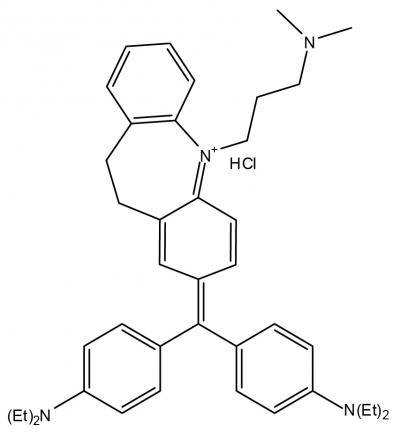
This is the chemical representation of imipramine blue, an organic triphenylmethane dye that appears to improve brain cancer treatment in small animals by altering the regulation of actin and the production of reactive oxygen species.
Georgia Tech/Jennifer Munson
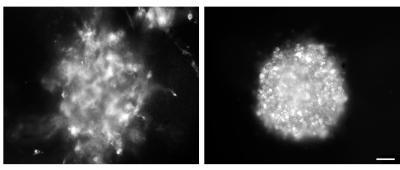
These images show that imipramine blue inhibits the invasion and growth of glioblastoma cells in culture. Glioblastoma cells on the left have been treated with ethanol and cells on the right have been treated with imipramine blue.
Georgia Tech/Jennifer Munson
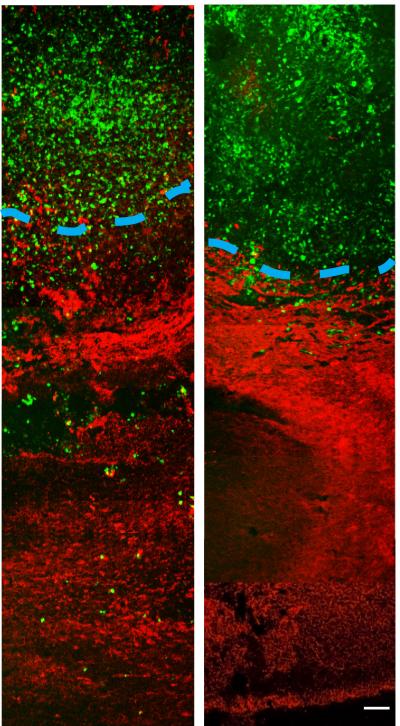
These images show that in vivo delivery of imipramine blue yields decreased invasion of the tumor into healthy tissue. On the left is an untreated tumor and on the right is a tumor treated with imipramine blue. To quantify cellular invasion beyond the tumor border (blue dotted line), researchers count the number of glioma cells (green) per area of healthy tissue (red).
Georgia Tech/Jennifer Munson

Treating invasive brain tumors with a combination of chemotherapy and radiation has improved clinical outcomes, but few patients survive longer than two years after diagnosis. The effectiveness of the treatment is limited by the tumor's aggressive invasion of healthy brain tissue, which restricts chemotherapy access to the cancer cells and complicates surgical removal of the tumor. To address this challenge, researchers from the Georgia Institute of Technology and Emory University have designed a new treatment approach that appears to halt the spread of cancer cells into normal brain tissue in animal models. The researchers treated animals possessing an invasive tumor with a vesicle carrying a molecule called imipramine blue, followed by conventional doxorubicin chemotherapy. The tumors ceased their invasion of healthy tissue and the animals survived longer than animals treated with chemotherapy alone.
"Our results show that imipramine blue stops tumor invasion into healthy tissue and enhances the efficacy of chemotherapy, which suggests that chemotherapy may be more effective when the target is stationary," said Ravi Bellamkonda, a professor in the Wallace H. Coulter Department of Biomedical Engineering at Georgia Tech and Emory University. "These results reveal a new strategy for treating brain cancer that could improve clinical outcomes."
The results of this work were published on March 28, 2012 in the journal Science Translational Medicine. The research was supported primarily by the Ian's Friends Foundation and partially by the Georgia Cancer Coalition, the Wallace H. Coulter Foundation and a National Science Foundation graduate research fellowship.
In addition to Bellamkonda, collaborators on the project include Jack Arbiser, a professor in the Emory University Department of Dermatology; Daniel Brat, a professor in the Emory University Department of Pathology and Laboratory Medicine; and the paper's lead author, Jennifer Munson, a former Fulbright Scholar who was a bioengineering graduate student in the Georgia Tech School of Chemical & Biomolecular Engineering when the research was conducted.
Arbiser designed the novel imipramine blue compound, which is an organic triphenylmethane dye. After in vitro experiments showed that imipramine blue effectively inhibited movement of several cancer cell lines, the researchers tested the compound in an animal model of aggressive cancer that exhibited attributes similar to a human brain tumor called glioblastoma.
"There were many reasons why we chose to use the RT2 astrocytoma rat model for these experiments," said Brat. "The tumor exhibited properties of aggressive growth, invasiveness, angiogenesis and necrosis that are similar to human glioblastoma; the model utilized an intact immune system, which is seen in the human disease; and the model enabled increased visualization by MRI because it was a rat model, rather than a mouse."
Because imipramine blue is hydrophobic and doxorubicin is cytotoxic, the researchers encapsulated each compound in an artificially-prepared vesicle called a liposome so that the drugs would reach the brain. The liposomal drug delivery vehicle also ensured that the drugs would not be released into tissue until they passed through leaky blood vessel walls, which are only present where a tumor is growing.
Animals received one of the following four treatments: liposomes filled with saline, liposomes filled with imipramine blue, liposomes filled with doxorubicin chemotherapy, or liposomes filled with imipramine blue followed by liposomes filled with doxorubicin chemotherapy.
All of the animals that received the sequential treatment of imipramine blue followed by doxorubicin chemotherapy survived for 200 days -- more than 6 months -- with no observable tumor mass. Of the animals treated with doxorubicin chemotherapy alone, 33 percent were alive after 200 days with a median survival time of 44 days. Animals that received capsules filled with saline or imipramine blue -- but no chemotherapy -- did not survive more than 19 days.
"Our results show that the increased effectiveness of the chemotherapy treatment is not because of a synergistic toxicity between imipramine blue and doxorubicin. Imipramine blue is not making the doxorubicin more toxic, it's simply stopping the movement of the cancer cells and containing the cancer so that the chemotherapy can do a better job," explained Bellamkonda, who is also the Carol Ann and David D. Flanagan Chair in Biomedical Engineering and a Georgia Cancer Coalition Distinguished Cancer Scholar.
MRI results showed a reduction and compaction of the tumor in animals treated with imipramine blue followed by doxorubicin chemotherapy, while animals treated with chemotherapy alone presented with abnormal tissue and glioma cells. MRI also indicated that the blood-brain barrier breach often seen during tumor growth was present in the animals treated with chemotherapy alone, but not the group treated with chemotherapy and imipramine blue.
According to the researchers, imipramine blue appears to improve the outcome of brain cancer treatment by altering the regulation of actin, a protein found in all eukaryotic cells. Actin mediates a variety of essential biological functions, including the production of reactive oxygen species. Most cancer cells exhibit overproduction of reactive oxygen species, which are thought to stimulate cancer cells to invade healthy tissue. The dye's reorganization of the actin cytoskeleton is thought to inhibit production of enzymes that produce reactive oxygen species.
"I formulated the imipramine blue compound as a triphenylmethane dye because I knew that another triphenylmethane dye, gentian violet, exhibited anti-cancer properties, and I decided to use imipramine -- a drug used to treat depression -- as the starting material because I knew it could get into the brain," said Arbiser.
For future studies, the researchers are planning to test imipramine blue's effect on animal models with invasive brain tumors, metastatic tumors, and other types of cancer such as prostate and breast.
"While we need to conduct future studies to determine if the effect of imipramine blue is the same for different types of cancer diagnosed at different stages, this initial study shows the possibility that imipramine blue may be useful as soon as any tumor is diagnosed, before anti-cancer treatment begins, to create a more treatable tumor and enhance clinical outcome," noted Bellamkonda.

**Source: Georgia Institute of Technology Research News

El tomillo se ha revelado como un un remedio potencial contra el acné


Tomillo, un potencial remedio natural contra el acné
jjramos (flickr)
El acné afecta es un trastorno que afecta a casi todas las personas en algún momento de la vida, aunque se presenta sobre todo en la adolescencia, cuando las hormonas están revolucionadas. Existen en el mercado multitud de cremas, geles y lociones para mitigarlo, pero ahora, investigadores de la Universidad Metropolitana de Leeds han descubierto que un preparado a base de tomillo resulta más eficaz incluso que las pomadas con receta.
La investigación, presentada esta semana en la Conferencia de la Sociedad General de Microbiología, asegura que el tomillo puede convertirse en un remedio eficaz y suave para la piel afectada por esta enfermedad inflamatoria de la piel.
Los científicos pusieron a prueba la efectividad del tomillo, la caléndula y la mirra contra la bacteria del acné, mediante unos preparados en alcohol. El grupo encontró que, aunque todas las soluciones conseguían destruir la bacteria tras una exposición de cinco minutos, el tomillo fue el más efectivo de los tres. Es más, descubrieron que la tintura de esta planta tiene un efecto antibacteriano mayor que el peróxido de benzoilo, el ingrediente activo presente en la mayoría de las cremas antiacné.
Los investigadores comprobaron además que la eficacia antibacteriana de las tinturas no se debían solo a la capacidad esterilizadora del alcohol.
Estos resultados preliminares suponen el primer paso para futuras investigaciones del uso de estas soluciones herbales en el tratamientos del acné. «Ahora necesitamos hacer otras pruebas en condiciones más cercanas al ambiente real de la piel y ver cómo estos preparados trabajan a nivel molecular. Si se prueba que la tintura de tomillo es clínicamente efectiva, como sugieren nuestros rsultados, podemos estar ante una alternativa natural a los actuales tratamientos», explica la doctora Margarita Gómez-Escalada, autora principal del estudio.
El tratamiento herbal del acné supondría una muy buena noticia para aquellos que tienen una piel excesivamente sensible para las cremas disponibles en el mercado. «El problema de los tratamientos que contienen peróxido de benzoilo son los efectos secundarios, como la irritación de la piel», señala la doctora Gómez-Escalada, que asegura que los preparados a base de plantas son menos agresivos por sus propiedades antiinflamatorias. 

**Publicado en "VOCENTO"

CONTACTO · Aviso Legal · Política de Privacidad · Política de Cookies

Copyright © Noticia de Salud