La asociación de lucha contra la lepra «Fontilles» ha lanzado una campaña con historias reales de personas que sufren las consecuencias físicas y sociales de esta enfermedad pero que no están incluidas en las estadísticas oficiales. En el marco de los actos programados para conmemorar el Día Mundial de la Lucha contra la Lepra, la campaña pone de manifiesto que las cifras que registra la Organización Mundial de la Salud (OMS) solo tienen en cuenta los casos nuevos notificados por países endémicos y aquellos que están recibiendo tratamiento.
Éstos tan sólo representan un pequeño fragmento del total de personas que padecen las consecuencias físicas o sociales de la lepra, ha informado Fontilles en una nota de prensa.
Según la OMS, entre uno y dos millones de afectados viven con discapacidades permanentes como consecuencia de esta patología, mientras que la Federación Internacional de Lucha contra la Lepra, de la que Fontilles es miembro, calcula que pueden ser tres millones.
«Con esta campaña queremos dar mayor visibilidad a las personas afectadas por la lepra que no figuran en las estadísticas», afirman desde la asociación.
A principios de 2011, 130 países notificaron a la OMS un total de 228.474 nuevos casos de lepra y, de éstos, 17 concentran el 95% de los nuevos enfermos.
India, la más afectada
Una vez más, India encabeza la lista con 126.800 nuevos afectados; seguida de Brasil, con 34.894 e Indonesia, con 17.012, y junto a éstos, RD Congo, Etiopía, Nigeria, Nepal, Bangladesh y Myanmar son los países más endémicos.
Desde Fontilles aclaran que las estadísticas no recogen los casos de algunos países que carecen de medios para diagnosticar y controlar la enfermedad, por lo que no la declaran. Por otra parte, muchos gobiernos no quieren que sus países sean vinculados con esta dolencia y presionan a los servicios sanitarios para reducir las estadísticas, lo que imposibilita conocer los datos reales sobre la incidencia de la lepra entre la población.
«Es necesario conocer el número de personas que sufren de discapacidad y que están en riesgo de nuevas infecciones», matiza la asociación, para advertir de que la falta de cifras oficiales impide entender la magnitud del problema y, por tanto, dedicar los recursos necesarios e implementar las políticas adecuadas para combatirla.
-Apoyo del Vaticano
El Vaticano también se ha unido en esta reclamación. El presidente del Pontificio Consejo para los Agentes Sanitarios, el arzobispo Zigmunt Zimowski, ha pedido a los gobiernos y organismos internacionales que aumenten la atención y el trabajo contra la difusión de la lepra, en un mensaje titulado «En la lucha contra la enfermedad de Hansen es necesario el compromiso de todos», escrito con motivo de la celebración este domingo de la LIX Jornada Mundial de los Enfermos de Lepra. Aunque reconoce que se han logrado «éxitos» en términos de «fuerte reducción» del número de infectados, precisa que esto «no exime ciertamente a los gobiernos y a los organismos internacionales de sus responsabilidades por lo que se refiere a la prevención, a la 'readmisión' de la persona curada, así como al apoyo a todas las víctimas de la infección».
-Estigma y marginación
Las cifras tampoco reflejan el estigma y la marginación social que siguen sufriendo aquellas personas que padecen lepra así como sus familiares, una situación que se ve agravada por leyes discriminatorias y que siguen vigentes en algunos países endémicos.
En cuanto a la evolución de la enfermedad en España, se ha mantenido en torno a los 15-25 casos nuevos anuales, muchos de los cuales proceden del extranjero, pero existen también algunos autóctonos en zonas de Andalucía, Galicia y Levante.
**Publicado en "ABC"
30 January 2012
Stealthy leprosy pathogen evades critical vitamin D-dependent immune response

A team of UCLA scientists has found that the pathogen that causes leprosy has a remarkable ability to avoid the human immune system by inhibiting the antimicrobial responses important to our defenses. In one of the first laboratory studies of its kind, researchers discovered that the leprosy pathogen Mycobacterium leprae was able to reduce and evade immune activity that is dependent on vitamin D, a natural hormone that plays an essential role in the body's fight against infections.
The pathogen manipulated micro-RNAs, tiny molecules made of ribonucleic acids that carry information and that help regulate genes to direct cell activity, including immune system defenses. Micro-RNAs are short RNAs that do not code information for proteins, which carry out all cell activity; rather, they bind to the RNAs that do code for proteins and block them.
Published in the Jan. 29 online edition of the journal Nature Medicine, the findings demonstrate how an infectious disease pathogen like M. leprae can use micro-RNAs to impact the immune system's fight response.
"We may find that these tiny micro-RNAs can be exploited by pathogens to weaken our immune response," said the study's first author, Dr. Philip T. Liu, an assistant professor of medicine at the Orthopaedic Hospital Research Center and in the department of dermatology at the David Geffen School of Medicine at UCLA. "By better understanding how pathogens can escape our immune cells, we can design more effective therapies to boost our immune responses to these difficult to treat infections like leprosy."
Leprosy, one of the world's oldest known diseases, is a chronic infectious disease that affects the skin, the peripheral nerves, the upper respiratory tract and the eyes and can lead to disfigurement of the hands, face and feet. In 2008, approximately 249,000 new cases of leprosy were reported worldwide, according to the World Health Organization.
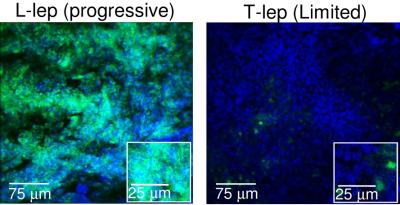
For the study, researchers compared the micro-RNAs in human skin lesions from two types of leprosy: tuberloid leprosy, a milder infection that is more easily contained, and lepromatous leprosy, which is more serious and causes widespread infection throughout the body.
In the lab, the scientists identified 13 micro-RNAs that differed between the two types of leprosy. The micro-RNAs that were found to be more common in lepromatous leprosy seemed to target the genes important for directing key immune system cells, including macrophages and T cells.
The team found that a particular micro-RNA, hsa-mir-21, inhibited the gene activity of the vitamin D-dependent immune pathway used to help fight infection. When researchers neutralized the activity of hsa-mir-21 in macrophages, the cells were able to kill the bacteria again.
"The leprosy pathogen was able to effectively evade the host's immune response by regulating critical immune system genes," said senior investigator Dr. Robert Modlin, UCLA's Klein Professor of Dermatology and chief of dermatology at the Geffen School of Medicine. "It's like having the enemy sending a decoy message to your combat troops and telling them to lower their weapons."
To test the significance of this micro-RNA with other infectious diseases, the researchers also introduced hsa-mir-21 to human macrophages that were then infected with tuberculosis in the lab. Researchers found that the micro-RNA similarly blocked the ability of the macrophages to kill the bacteria.
Researchers also demonstrated that immune activation of the leprosy-infected immune cells decreased the leprosy bacteria's viability four-fold -- but only when hsa-mir-21 activity was silenced. In fact, an over-expression of this micro-RNA blocked immune activity, resulting in a five-fold increase in bacterial viability.
"We were surprised at the devastating effects that even a single micro-RNA had on the ability of immune cells to fight the infections," Liu said.
In addition, the team showed that this micro-RNA was found in human immune cells only 18 hours after the onset of leprosy infection. The presence of the micro-RNA so early in the infection suggests it might play a role in actual disease development, the researchers said.
Further investigation of this single micro-RNA in leprosy may provide a framework for analyzing other micro-RNAs to help determine their cumulative role in regulating the immune response.
The micro-RNAs are small, and therefore it is possible to develop treatments which neutralize them, the researchers said.
"We may find that a combination of vitamin D supplementation with a genetically targeted therapy could provide an optimal treatment approach to leprosy and possibly other chronic infectious diseases," said Modlin, who also serves as vice chair for cutaneous medicine and dermatological research at UCLA and is a distinguished professor of medicine and of microbiology, immunology and molecular genetics.
"Vitamin D insufficiency has been associated with a number of infectious and autoimmune diseases, cardiovascular disease and cancers," Modlin added. "Our study indicates that micro-RNAs can alter human vitamin D responses and contribute to disease pathology."
Dr. Barry Bloom of Harvard University, who was not an author of this study but is part of the research team studying this field, agreed.
"Such a novel approach may be especially worth exploring in treatment of drug-resistant pathogens such as some forms of tuberculosis, where antimicrobial therapy is becoming increasingly problematic," Bloom said.
The pathogen manipulated micro-RNAs, tiny molecules made of ribonucleic acids that carry information and that help regulate genes to direct cell activity, including immune system defenses. Micro-RNAs are short RNAs that do not code information for proteins, which carry out all cell activity; rather, they bind to the RNAs that do code for proteins and block them.
Published in the Jan. 29 online edition of the journal Nature Medicine, the findings demonstrate how an infectious disease pathogen like M. leprae can use micro-RNAs to impact the immune system's fight response.
"We may find that these tiny micro-RNAs can be exploited by pathogens to weaken our immune response," said the study's first author, Dr. Philip T. Liu, an assistant professor of medicine at the Orthopaedic Hospital Research Center and in the department of dermatology at the David Geffen School of Medicine at UCLA. "By better understanding how pathogens can escape our immune cells, we can design more effective therapies to boost our immune responses to these difficult to treat infections like leprosy."
Leprosy, one of the world's oldest known diseases, is a chronic infectious disease that affects the skin, the peripheral nerves, the upper respiratory tract and the eyes and can lead to disfigurement of the hands, face and feet. In 2008, approximately 249,000 new cases of leprosy were reported worldwide, according to the World Health Organization.
For the study, researchers compared the micro-RNAs in human skin lesions from two types of leprosy: tuberloid leprosy, a milder infection that is more easily contained, and lepromatous leprosy, which is more serious and causes widespread infection throughout the body.
In the lab, the scientists identified 13 micro-RNAs that differed between the two types of leprosy. The micro-RNAs that were found to be more common in lepromatous leprosy seemed to target the genes important for directing key immune system cells, including macrophages and T cells.
The team found that a particular micro-RNA, hsa-mir-21, inhibited the gene activity of the vitamin D-dependent immune pathway used to help fight infection. When researchers neutralized the activity of hsa-mir-21 in macrophages, the cells were able to kill the bacteria again.
"The leprosy pathogen was able to effectively evade the host's immune response by regulating critical immune system genes," said senior investigator Dr. Robert Modlin, UCLA's Klein Professor of Dermatology and chief of dermatology at the Geffen School of Medicine. "It's like having the enemy sending a decoy message to your combat troops and telling them to lower their weapons."
To test the significance of this micro-RNA with other infectious diseases, the researchers also introduced hsa-mir-21 to human macrophages that were then infected with tuberculosis in the lab. Researchers found that the micro-RNA similarly blocked the ability of the macrophages to kill the bacteria.
Researchers also demonstrated that immune activation of the leprosy-infected immune cells decreased the leprosy bacteria's viability four-fold -- but only when hsa-mir-21 activity was silenced. In fact, an over-expression of this micro-RNA blocked immune activity, resulting in a five-fold increase in bacterial viability.
"We were surprised at the devastating effects that even a single micro-RNA had on the ability of immune cells to fight the infections," Liu said.
In addition, the team showed that this micro-RNA was found in human immune cells only 18 hours after the onset of leprosy infection. The presence of the micro-RNA so early in the infection suggests it might play a role in actual disease development, the researchers said.
Further investigation of this single micro-RNA in leprosy may provide a framework for analyzing other micro-RNAs to help determine their cumulative role in regulating the immune response.
The micro-RNAs are small, and therefore it is possible to develop treatments which neutralize them, the researchers said.
"We may find that a combination of vitamin D supplementation with a genetically targeted therapy could provide an optimal treatment approach to leprosy and possibly other chronic infectious diseases," said Modlin, who also serves as vice chair for cutaneous medicine and dermatological research at UCLA and is a distinguished professor of medicine and of microbiology, immunology and molecular genetics.
"Vitamin D insufficiency has been associated with a number of infectious and autoimmune diseases, cardiovascular disease and cancers," Modlin added. "Our study indicates that micro-RNAs can alter human vitamin D responses and contribute to disease pathology."
Dr. Barry Bloom of Harvard University, who was not an author of this study but is part of the research team studying this field, agreed.
"Such a novel approach may be especially worth exploring in treatment of drug-resistant pathogens such as some forms of tuberculosis, where antimicrobial therapy is becoming increasingly problematic," Bloom said.
**Source: University of California, Los Angeles
España: los inspectores de Trabajo obligarán a contratrar el 2% de discapacitados
Los inspectores de Trabajo se van a encargar de velar por que las empresas de más de 50 trabajadores cumplan con la ley vigente y reserven un 2% de sus puestos de trabajo a personas con algún tipo de discapacidad. Según informó a ABC el nuevo director general de Discapacidad, Ignacio Tremiño, desde el Ministerio de Sanidad, Igualdad y Servicios Sociales ya se está trabajando con el de Trabajo para que sus inspectores se involucren en esta tarea.
Ésta será la medida estrella con la que se llevará a la práctica el compromiso expresado recientemente por la ministra Ana Mato para que se haga cumplir esa reserva del 2% prevista en la ley, con el objetivo de «continuar la lucha por la igualdad real de oportunidades para este colectivo».
La ley de integración social de los minusválidos, aprobada en 1982, establece que «las empresas públicas y privadas que empleen un número de trabajadores fijos que exceda de cincuenta vendrán obligadas a emplear un número de trabajadores minusválidos no inferior al dos por ciento de la plantilla». Sin embargo, según la Confederación Española de Personas con Discapacidad Física y Orgánica (Cocemfe), solo cumplen con este precepto un tercio de las empresas que están obligadas.
El Ministerio pretende que las personas con discapacidad trabajen en las empresas «ordinarias» y que se reduzca «la distancia entre la población activa con discapacidad y sin discapacidad» asegura el director general de Discapacidad. Para ello se hará «un esfuerzo para hacer cumplir la ley con inspecciones y coordinación con otros ministerios y los órganos competentes para que se vigile por el cumplimento de la ley». Se va a potenciar asimismo el desarrollo de las normas en materia de discapacidad aprobadas en las Cortes para que se apliquen «de forma transversal para todos los ministerios». Según Ignacio Tremiño, «no hará falta una dirección general de Discapacidad el día en que las personas con discapacidad estén normalizadas en el resto de la sociedad, sean personas que tengan las mismas oportunidades que el resto de ciudadanos».
-En silla de ruedas desde hace 22 años
Ignacio Tremiño se mueve en silla de ruedas desde que sufrió un accidente de tráfico hace 22 años. Fue concejal de Acción Social en Valladolid de 1999 a 2000 y desde el pasado mayo era director de Desarrollo de Negocio de la Corporación Empresarial ONCE y de Fundosa Grupo. Además, es vicepresidente de la Comisión de Discapacidad PP desde 2007.
**Publicado en "ABC"
Ésta será la medida estrella con la que se llevará a la práctica el compromiso expresado recientemente por la ministra Ana Mato para que se haga cumplir esa reserva del 2% prevista en la ley, con el objetivo de «continuar la lucha por la igualdad real de oportunidades para este colectivo».
La ley de integración social de los minusválidos, aprobada en 1982, establece que «las empresas públicas y privadas que empleen un número de trabajadores fijos que exceda de cincuenta vendrán obligadas a emplear un número de trabajadores minusválidos no inferior al dos por ciento de la plantilla». Sin embargo, según la Confederación Española de Personas con Discapacidad Física y Orgánica (Cocemfe), solo cumplen con este precepto un tercio de las empresas que están obligadas.
El Ministerio pretende que las personas con discapacidad trabajen en las empresas «ordinarias» y que se reduzca «la distancia entre la población activa con discapacidad y sin discapacidad» asegura el director general de Discapacidad. Para ello se hará «un esfuerzo para hacer cumplir la ley con inspecciones y coordinación con otros ministerios y los órganos competentes para que se vigile por el cumplimento de la ley». Se va a potenciar asimismo el desarrollo de las normas en materia de discapacidad aprobadas en las Cortes para que se apliquen «de forma transversal para todos los ministerios». Según Ignacio Tremiño, «no hará falta una dirección general de Discapacidad el día en que las personas con discapacidad estén normalizadas en el resto de la sociedad, sean personas que tengan las mismas oportunidades que el resto de ciudadanos».
-En silla de ruedas desde hace 22 años
Ignacio Tremiño se mueve en silla de ruedas desde que sufrió un accidente de tráfico hace 22 años. Fue concejal de Acción Social en Valladolid de 1999 a 2000 y desde el pasado mayo era director de Desarrollo de Negocio de la Corporación Empresarial ONCE y de Fundosa Grupo. Además, es vicepresidente de la Comisión de Discapacidad PP desde 2007.
**Publicado en "ABC"
Diagnostic brain tumor test could revolutionize care of patients

Researchers at UT Southwestern Medical Center have developed what they believe to be the first clinical application of a new imaging technique to diagnose brain tumors. The unique test could preclude the need for surgery in patients whose tumors are located in areas of the brain too dangerous to biopsy. This new magnetic resonance spectroscopy (MRS) technique provides a definitive diagnosis of cancer based on imaging of a protein associated with a mutated gene found in 80 percent of low- and intermediate-grade gliomas. Presence of the mutation also means a better prognosis.
"To our knowledge, this is the only direct metabolic consequence of a genetic mutation in a cancer cell that can be identified through noninvasive imaging," said Dr. Elizabeth Maher, associate professor of internal medicine and neurology at UT Southwestern and senior author of the study, available online in Nature Medicine. "This is a major breakthrough for brain tumor patients."
UT Southwestern researchers developed the test by modifying the settings of a magnetic resonance imaging (MRI) scanner to track the protein's levels. The data acquisition and analysis procedure was developed by study lead author Dr. Changho Choi, associate professor of the Advanced Imaging Research Center (AIRC) and radiology. Previous research linked high levels of this protein to the mutation, and UT Southwestern researchers already had been working on MRS of gliomas to find tumor biomarkers.
"Our next step is to make this testing procedure widely available as part of routine MRIs for brain tumors. It doesn't require any injections or special equipment," said Dr. Maher, medical director of UT Southwestern's neuro-oncology program.
To substantiate the test as a diagnostic tool, biopsy samples from 30 glioma patients enrolled in the UT Southwestern clinical trial were analyzed; half had the mutation and expected high levels of the protein. MRS imaging of these patients had been done before surgery and predicted, with 100 percent accuracy, which patients had the mutation.
For Thomas Smith of Grand Prairie, the test helped determine the best time to begin chemotherapy. When an MRS scan showed a sharp rise in the 25-year-old's protein levels, this indicated to his health care team that his tumor was moving from dormancy to rapid growth.
"We treated him with chemotherapy and his protein levels came down," Dr. Maher said.
Before participating in the study, Mr. Smith had tumor removal surgery in 2007. Because part of the tumor could not be safely removed, however, he continued to suffer seizures and had other neurological problems. Since chemotherapy, his symptoms have diminished.
"I did six rounds of chemo, every six weeks," Mr. Smith said. "My seizures stopped and all my symptoms improved. I am only on anti-seizure medication now."
Other UT Southwestern researchers involved in the study included Sandeep Ganji, a doctorate student in radiological sciences; Dr. Ralph DeBerardinis, assistant professor of pediatrics and with the Eugene McDermott Center for Human Growth and Development; Dr. Kimmo Hatanpaa, associate professor of pathology; Dr. Dinesh Rakheja, assistant professor of pathology; Dr. Zoltan Kovacs, assistant professor in the AIRC; Drs. Xiao-Li Yang and Tomoyuki Mashimo, both senior research scientists in internal medicine; Dr. Jack Raisanen, professor of pathology; Dr. Isaac Marin-Valencia, resident in pediatrics; Dr. Juan Pascual, assistant professor of neurology and neurotherapeutics, pediatrics, and physiology; Dr. Christopher Madden, associate professor of neurological surgery; Dr. Bruce Mickey, professor of neurological surgery and otolaryngology-head and neck surgery, and radiation oncology; Dr. Craig Malloy, professor in the AIRC and of internal medicine and radiology; and Dr. Robert Bachoo, assistant professor in neurology and neurotherapeutics, and internal medicine.
The research was supported by grants from the National Institutes of Health, the Cancer Prevention and Research Institute of Texas and financial support from the Annette G. Strauss Center for Neuro-oncology at UT Southwestern.
**Source: UT Southwestern Medical Center
Un nuevo portal web para fomentar hábitos saludables y proteger la salud: www.educatumundo.com
El portal web www.educatumundo.com acaba de ponerse en marcha con el objetivo de fomentar la adquisición de hábitos saludables y preventivos que ayuden a proteger la salud y a mejorar la calidad de vida de la sociedad.
Este proyecto pone a disposición de niños, familias y profesores contenidos educativos gratuitos elaborados por Fundación Mapfre a través del Instituto de Prevención, Salud y Medio Ambiente. La web consta de diferentes secciones: una infantil y juvenil (dirigida a niños de 3 y 12 años), otra dirigida a las familias, y una tercera, orientada a los profesionales de la educación.
La sección infantil ‘Chicos y Chicas’ es un punto de encuentro donde los más jóvenes son los protagonistas. Aquí van a tener la ocasión de aprender de forma divertida a reducir la contaminación y a hacer más sostenible el planeta; a prevenir accidentes que ocurren en el hogar y durante el tiempo libre; y a ser conscientes de la importancia de cuidar la salud a través del ejercicio y una alimentación adecuada. Esta sección cuenta con una zona de juegos, videos en 3D, cómics y cuentos sobre el ahorro de agua y energía, y un apartado con noticias relacionadas con la prevención, la salud y el medio ambiente.
Además, esta sección cuenta con Prevenland un mundo virtual que tiene por objetivo que los niños puedan divertirse, chatear y jugar con otros usuarios, siempre de manera segura, y con un trasfondo educativo en prevención de accidentes, desarrollo de hábitos de vida saludables y conservación del medio ambiente, transmitiendo con todo ello valores educativos y sociales.
La sección ‘Familia’ ofrece material y recursos educativos especializados en la promoción de la salud, la prevención de lesiones y enfermedades y la disminución de la contaminación. Numerosos expertos en diferentes materias ofrecen en este espacio sus recomendaciones sobre temas cotidianos relacionados con la protección de la salud y el medio ambiente a través de vídeos explicativos. También cuenta con un foro donde los usuarios pueden realizar preguntas que serán contestadas por profesionales en las distintas materias; una ‘Casa Virtual’, donde se aportan consejos prácticos para toda la familia, especialmente dirigidos a minimizar los riesgos de accidentes en el hogar; y dos blogs, ‘Familias’ y ‘Comparte actividades con tus hijos’, moderados por profesionales de la Agencia EFE sobre temas de actualidad.
Por último, la sección ‘Profesores’ pone a disposición de este colectivo material didáctico y recursos educativos dirigidos a fomentar el cuidado de la salud y la prevención de enfermedades y lesiones, así como contribuir a cuidar el medio ambiente.
Este proyecto pone a disposición de niños, familias y profesores contenidos educativos gratuitos elaborados por Fundación Mapfre a través del Instituto de Prevención, Salud y Medio Ambiente. La web consta de diferentes secciones: una infantil y juvenil (dirigida a niños de 3 y 12 años), otra dirigida a las familias, y una tercera, orientada a los profesionales de la educación.
La sección infantil ‘Chicos y Chicas’ es un punto de encuentro donde los más jóvenes son los protagonistas. Aquí van a tener la ocasión de aprender de forma divertida a reducir la contaminación y a hacer más sostenible el planeta; a prevenir accidentes que ocurren en el hogar y durante el tiempo libre; y a ser conscientes de la importancia de cuidar la salud a través del ejercicio y una alimentación adecuada. Esta sección cuenta con una zona de juegos, videos en 3D, cómics y cuentos sobre el ahorro de agua y energía, y un apartado con noticias relacionadas con la prevención, la salud y el medio ambiente.
Además, esta sección cuenta con Prevenland un mundo virtual que tiene por objetivo que los niños puedan divertirse, chatear y jugar con otros usuarios, siempre de manera segura, y con un trasfondo educativo en prevención de accidentes, desarrollo de hábitos de vida saludables y conservación del medio ambiente, transmitiendo con todo ello valores educativos y sociales.
La sección ‘Familia’ ofrece material y recursos educativos especializados en la promoción de la salud, la prevención de lesiones y enfermedades y la disminución de la contaminación. Numerosos expertos en diferentes materias ofrecen en este espacio sus recomendaciones sobre temas cotidianos relacionados con la protección de la salud y el medio ambiente a través de vídeos explicativos. También cuenta con un foro donde los usuarios pueden realizar preguntas que serán contestadas por profesionales en las distintas materias; una ‘Casa Virtual’, donde se aportan consejos prácticos para toda la familia, especialmente dirigidos a minimizar los riesgos de accidentes en el hogar; y dos blogs, ‘Familias’ y ‘Comparte actividades con tus hijos’, moderados por profesionales de la Agencia EFE sobre temas de actualidad.
Por último, la sección ‘Profesores’ pone a disposición de este colectivo material didáctico y recursos educativos dirigidos a fomentar el cuidado de la salud y la prevención de enfermedades y lesiones, así como contribuir a cuidar el medio ambiente.
Farmacéuticos Sin Fronteras inicia un programa de microcréditos y nutrición en Haití

Farmacéuticos Sin Fronteras (FSFE) ha puesto en marcha un programa de microcréditos y acciones de nutrición en Jean Rabel (Haití) completando así las actividades previstas con los fondos recogidos tras las campañas iniciadas a raíz del terremoto sufrido por este país a primeros de 2010.
Desde la ONG explicaron que este programa servirá para colaborar en la reactivación económica de Jean Rabel, situado en la zona norte del país, además de facilitar el establecimiento permanente de un programa de nutrición a la población infantil de los cinco colegios gestionados por la contraparte, las Hermanas de Jesús María (HJM), encargadas de la gestión de los microcréditos. Esto será posible porque los intereses generados por los mismos se destinarán a este programa nutricional.
Desde la ONG explicaron que este programa servirá para colaborar en la reactivación económica de Jean Rabel, situado en la zona norte del país, además de facilitar el establecimiento permanente de un programa de nutrición a la población infantil de los cinco colegios gestionados por la contraparte, las Hermanas de Jesús María (HJM), encargadas de la gestión de los microcréditos. Esto será posible porque los intereses generados por los mismos se destinarán a este programa nutricional.
-Cien microcréditos
Se concederán un total de cien microcréditos para la puesta en funcionamiento de otros tantos microempresas, dedicadas a comercio de pescado, el textil, y restauración, señalaron desde Farmacéuticos Sin Fronteras. El programa nutricional, contará con varias actividades, entre las que se incluyen las analíticas correspondientes a los niños, la formación básica en higiene alimentaria y por supuesto el almuerzo escolar que en ocasiones es el único aporte alimentario para ellos.
Tanto el programa de los microcréditos como el programa de nutrición serán permanentes y se podrán ejecutar gracias a la participación de las Hermanas de Jesús María, encargadas de la gestión del proyecto en el terreno. Además al inicio del proyecto se enviará un cooperante de Farmacéuticos Sin Fronteras, con el compromiso del envío de personal de nuestra entidad en los periodos que el programa determine. Tanto FSFE como HJM harán un informe semestral que permitirá el seguimiento de los programas que podrá ser ampliado en base a las evaluaciones recibidas. Finalmente desde FSFE avanzaron que preparan una exposición fotográfica virtual, dirigida a dar a conocer en los diferentes canales de Internet el trabajo de esta entidad en Haití.
Se concederán un total de cien microcréditos para la puesta en funcionamiento de otros tantos microempresas, dedicadas a comercio de pescado, el textil, y restauración, señalaron desde Farmacéuticos Sin Fronteras. El programa nutricional, contará con varias actividades, entre las que se incluyen las analíticas correspondientes a los niños, la formación básica en higiene alimentaria y por supuesto el almuerzo escolar que en ocasiones es el único aporte alimentario para ellos.
Tanto el programa de los microcréditos como el programa de nutrición serán permanentes y se podrán ejecutar gracias a la participación de las Hermanas de Jesús María, encargadas de la gestión del proyecto en el terreno. Además al inicio del proyecto se enviará un cooperante de Farmacéuticos Sin Fronteras, con el compromiso del envío de personal de nuestra entidad en los periodos que el programa determine. Tanto FSFE como HJM harán un informe semestral que permitirá el seguimiento de los programas que podrá ser ampliado en base a las evaluaciones recibidas. Finalmente desde FSFE avanzaron que preparan una exposición fotográfica virtual, dirigida a dar a conocer en los diferentes canales de Internet el trabajo de esta entidad en Haití.
29 January 2012
Dr Daniel Uerbelhart and the solutions for the arthritis disease

The dr Daniel Uerbelhart( expert international Valmont Clinical, Switzerland) have speaked in exclusive for NOTICIAS DE SALUD during the presence in Barcelona for a Congress about diseases bornes.
-Can osteoarthritis, some day, disappear or be cured?
--It would be nice but I am not sure that this can really be reached because osteoarthritis is also linked with the aging of the population and more and more people are aging all over the world. So maybe we will have good solutions to prevent the beginning and also the progression but I think it is a utopia to think that we can totally eradicate osteoarthritis.
--It would be nice but I am not sure that this can really be reached because osteoarthritis is also linked with the aging of the population and more and more people are aging all over the world. So maybe we will have good solutions to prevent the beginning and also the progression but I think it is a utopia to think that we can totally eradicate osteoarthritis.
-The age of those affected by osteoarthritis is paradoxically lowering. Why is that?
--I have the feeling that, in an epidemiologic basis, because you have more and more people having active sport activities with micro to macro traumatisms, and of course this is a clear etiology of osteoarthritis. And also because in our society you have now more and more young people obese and this overweight problem is very important factor in developing the disease.
--I have the feeling that, in an epidemiologic basis, because you have more and more people having active sport activities with micro to macro traumatisms, and of course this is a clear etiology of osteoarthritis. And also because in our society you have now more and more young people obese and this overweight problem is very important factor in developing the disease.
-Is there a formula to prevent osteoarthritis?
--I think that everybody will tell you that is the same strategy that one for -preventing other health problems like cardiovascular diseases. People should stay not overweight, should eat normally, avoid to active sports that linked with micro and macro trauma. These are the kind of preventive measures that everybody knows but sometimes are difficult to apply.
--I think that everybody will tell you that is the same strategy that one for -preventing other health problems like cardiovascular diseases. People should stay not overweight, should eat normally, avoid to active sports that linked with micro and macro trauma. These are the kind of preventive measures that everybody knows but sometimes are difficult to apply.
-Dou you have any economic impact of the disease in Europe?
--I think that a couple of studies that were made (I have no numbers now to provide you) showed that it is huge because you have so many people affected, the population affected is aging so all this people contribute now to load in terms of economics of the social system.
--I think that a couple of studies that were made (I have no numbers now to provide you) showed that it is huge because you have so many people affected, the population affected is aging so all this people contribute now to load in terms of economics of the social system.
-What is the latest medicine to stop this degenerative process?
--Well, in Europe, the publication of the EULAR Recommendations for the treatment of knee osteoarthritis in 2003 has listed oral chondroitin sulphate as evidence 1A and strength of recommendation A which represents the highest level for a symptomatic therapeutic strategy. In USA, it is also recommended for knee and hip OA by the most recent OARSI Guidelines in 2010.
Apart from that, my feeling is that we can now answer with yes that chondroitin sulfate can stop the progression of osteoarthritis. We did a couple of studies (Michel et al. 2005 and Kahan et al. 2009) with aim of disease modifying or structure modifying effect of the substance that confirmed chondroitin sulfate can retard the progression of knee OA and can stop the progression in many cases.
Chondroitin sulfate belongs to the oral SYSADOA and the substance does have a delayed mode of action in OA which means that the first effects on pain and mobility can only be assessed after a couple of weeks of therapy (2-3 weeks) in sharp contrast with analgesics and NSAIDs which do act more rapidly (1-3 days). Importantly, when stopped after 3 months of continuous daily administration, CS will present in most cases with a remanent effect which can last for a couple of months in some cases, a feature which is never observed with analgesics and NSAIDs, substances which need to be continuously administered in order to provide relief in pain and increased mobility in OA patients.
--Well, in Europe, the publication of the EULAR Recommendations for the treatment of knee osteoarthritis in 2003 has listed oral chondroitin sulphate as evidence 1A and strength of recommendation A which represents the highest level for a symptomatic therapeutic strategy. In USA, it is also recommended for knee and hip OA by the most recent OARSI Guidelines in 2010.
Apart from that, my feeling is that we can now answer with yes that chondroitin sulfate can stop the progression of osteoarthritis. We did a couple of studies (Michel et al. 2005 and Kahan et al. 2009) with aim of disease modifying or structure modifying effect of the substance that confirmed chondroitin sulfate can retard the progression of knee OA and can stop the progression in many cases.
Chondroitin sulfate belongs to the oral SYSADOA and the substance does have a delayed mode of action in OA which means that the first effects on pain and mobility can only be assessed after a couple of weeks of therapy (2-3 weeks) in sharp contrast with analgesics and NSAIDs which do act more rapidly (1-3 days). Importantly, when stopped after 3 months of continuous daily administration, CS will present in most cases with a remanent effect which can last for a couple of months in some cases, a feature which is never observed with analgesics and NSAIDs, substances which need to be continuously administered in order to provide relief in pain and increased mobility in OA patients.
**Grateful to contact from BIOIBERICA FARMA
Subscribe to:
Comments (Atom)