Traductor

28 March 2012

Regular chocolate eaters are thinner


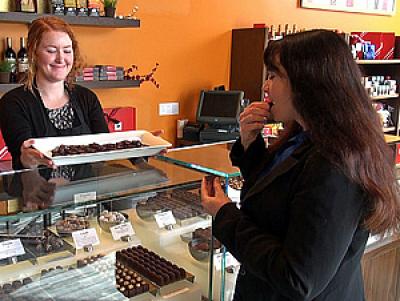
This is Beatrice Golomb, M.D, Ph.D. (right).
UC San Diego School of Medicine

Katherine Hepburn famously said of her slim physique: "What you see before you is the result of a lifetime of chocolate." New evidence suggests she may have been right. Beatrice Golomb, MD, PhD, associate professor in the Department of Medicine at the University of California, San Diego, and colleagues present new findings that may overturn the major objection to regular chocolate consumption: that it makes people fat. The study, showing that adults who eat chocolate on a regular basis are actually thinner that those who don't, will be published online in the Archives of Internal Medicine on March 26.
The authors dared to hypothesize that modest, regular chocolate consumption might be calorie-neutral -in other words, that the metabolic benefits of eating modest amounts of chocolate might lead to reduced fat deposition per calorie and approximately offset the added calories (thus rendering frequent, though modest, chocolate consumption neutral with regard to weight). To assess this hypothesis, the researchers examined dietary and other information provided by approximately 1000 adult men and women from San Diego, for whom weight and height had been measured.
The UC San Diego findings were even more favorable than the researchers conjectured. They found that adults who ate chocolate on more days a week were actually thinner -- i.e. had a lower body mass index -- than those who ate chocolate less often. The size of the effect was modest but the effect was "significant" -larger than could be explained by chance. This was despite the fact that those who ate chocolate more often did not eat fewer calories (they ate more), nor did they exercise more. Indeed, no differences in behaviors were identified that might explain the finding as a difference in calories taken in versus calories expended.
"Our findings appear to add to a body of information suggesting that the composition of calories, not just the number of them, matters for determining their ultimate impact on weight," said Golomb. "In the case of chocolate, this is good news -both for those who have a regular chocolate habit, and those who may wish to start one."

*Source: University of California, San Diego Health Sciences

El 7% de la población padece tos crónica


La tos crónica es aquella tos que persiste más allá de 8 semanas.
Molesta, irritante, discapacitante, etc. Son muchos los adjetivos que se le pueden poner a la tos crónica, una situación que no es una enfermedad en sí misma, pero que puede afectar profundamente la calidad de vida de una persona.

Se entiende por tos crónica como aquella «tos que persiste más allá de 8 semanas», explica Adalberto Pacheco Galván, de la Unidad de Asma y Tos Crónica, del Hospital Ramón y Cajal (Madrid). Aunque su incidencia está poco analizada, se calcula que en Europa, el 7% de la población adulta sufre tos crónica no ligada «a radiografía de tórax patológica ni a enfermedad pulmonar obstructiva crónica (EPOC)».

El problema, dice este experto, es que muchos pacientes se «adaptan» al problema que creen que es por un «mal catarro» por el humo del tabaco, o la contaminación de las ciudades. Esto es lo que le pasó a M. José Avellanada quien, desde que tiene memoria, recuerda tener tos. «A los 4 años tuve la tos ferina y desde entonces no he dejado de toser hasta 2009».
Siempre con tos
Cuando M. José habla de su vida siempre aparece la tos. «A mi en casa me decían ¿cómo es posible que estés toda la noche tosiendo?, pero yo no era consciente de ello. Lo cierto es que me levantaba hecha polvo, como si no hubiera dormido nada».
El problema es, asegura Pacheco, que «más de la mitad de tosedores crónicos permanecen sin diagnóstico y en un altísimo porcentaje van de especialista en especialista sin lograr solucionar su problema porque, la tos crónica, es un asunto multidisciplinar que abarca varias especialidades como otorrinolaringología, alergia, digestivo y neumología. Por eso -subraya- es preciso la existencia de Unidades de Tos Crónica donde se pueda aglutinar la información procedente de diversos orígenes y alcanzar así tasas de éxitos cercanas al 90%».
5 cosas que hay que saber sobre la tos crónica
1. ¿Es una enfermedad o consecuencia de otras?
No es una enfermedad, es un síntoma que puede ser más o menos predominante entre otros síntomas, y así, hay enfermedades donde la tos es un síntoma más como en la EPOC o el cáncer o la fibrosis pulmonar y otros, donde es el síntoma más importante como en el asma tipo tos o la enfermedad de vía aérea superior como la sinusitis-rinitis , o en el reflujo gastroesofágico o en la tos de origen en laringe. La tos es un «avisador» de que algo no funciona bien, y además, en vez de ser un mecanismo de defensa que todos debemos tener se convierte en algo molesto, y puede dar lugar a depresiones, o también síncopes por reducción del oxígeno cerebral en los golpes de tos, o incontinencia urinaria en las mujeres o incluso fractura de costillas tras golpes de tos.


2. ¿Quién debe diagnosticarla y tratarla?
Primero hay que descartar que la tos crónica avise de una enfermedad importante. Posteriormente, es preciso hacer una historia de fármacos porque algunos antihipertensivos pueden desencadenar tos crónica. Una vez hecha una radiografía de tórax y una espirometría, se debe llevar a cabo un estudio multidisciplinar.

3. ¿Cómo se debe tratar?
Hay que tratar todas las causas potenciales de tos crónica, de origen en tráquea- bronquio, esófago, sinusitis-rinitis y área de laringe con medicaciones especificas dirigidas a cada órgano o sistema requiriéndose a veces dos o mas tratamientos distintos para obtener un resultado óptimo. Si no se hace se convierte en un problema molesto o incluso se acepta por el paciente como «algo natural».
4. ¿Cuales son las comorbilidades más frecuentes?
El tosedor crónico suele ser portador de picor laríngeo, cosquilleos, carraspera, regurgitaciones frecuentes, ardores, pitos al respirar, rinitis frecuentes con secreciones transparentes y estornudos, depresiones y ansiedad, dolor de garganta etc.

5. ¿Cuál es la situación en España en cuanto a su manejo?
Mala, porque no existen Unidades Especializadas en Tos Crónica como ocurre en el norte de Europa o EE.UU., y cada especialista trata la tos en su ámbito produciéndose múltiples fracasos terapéuticos.

**Publicado en "ABC SALUD"

University of Maryland completes most extensive full face transplant to date


The University of Maryland released details today of the most extensive full face transplant completed to date, including both jaws, teeth, and tongue. The 36-hour operation occurred on March 19-20, 2012 at the R Adams Cowley Shock Trauma Center at the University of Maryland Medical Center and involved a multi-disciplinary team of faculty physicians from the University of Maryland School of Medicine and a team of over 150 nurses and professional staff. The face transplant, formally called a vascularized composite allograft (VCA), was part of a 72-hour marathon of transplant activity at one of the busiest transplant centers in the world. The family of one anonymous donor generously donated his face and also saved five other lives through the heroic gift of organ donation. Four of these transplants took place over the course of two days at the University of Maryland Medical Center.
The face transplant team was led by Eduardo D. Rodriguez, M.D., D.D.S., associate professor of surgery at the University of Maryland School of Medicine and chief of plastic, reconstructive and maxillofacial surgery at the R Adams Cowley Shock Trauma Center at the University of Maryland Medical Center. Dr. Rodriguez is board-certified in plastic and reconstructive surgery as well as in oral and maxillofacial surgery. This marks the first time in the world that a full face transplant was performed by a team of plastic and reconstructive surgeons with specialized training and expertise in craniofacial surgery and reconstructive microsurgery.
"We utilized innovative surgical practices and computerized techniques to precisely transplant the mid-face, maxilla and mandible including teeth, and a portion of the tongue. In addition, the transplant included all facial soft tissue from the scalp to the neck, including the underlying muscles to enable facial expression, and sensory and motor nerves to restore feeling and function," explains Dr. Rodriquez. "Our goal is to restore function as well as have aesthetically pleasing results."
The face transplant recipient, 37-year-old Richard Lee Norris of Hillsville, Virginia, was injured in 1997 in a gun accident. Since that time, he has undergone multiple life-saving and reconstructive surgeries. Due to the accident, Mr. Norris lost his lips and nose and had limited movement of his mouth. Mr. Norris first came to the University of Maryland Medical Center in 2005 to discuss reconstructive options with Dr. Rodriguez.
Grant funding from the Office of Naval Research (ONR) in the Department of Defense to Dr. Stephen Bartlett has supported the University of Maryland basic and clinical research program in vascularized composite transplantation leading up to and supporting this groundbreaking face transplant. The ONR funds medical research to support military operational medicine and clinical care of returning veterans. In addition to conducting research, the University of Maryland supports military medicine in a variety of ways, including training military medical staff prior to deployment and performing organ transplant surgeries for patients at Walter Reed/Bethesda National Naval Medical Center.
"The future of medicine depends on rapid translation of research and creating high-performing teams. The face transplant is a perfect example of the life-changing options we can provide for our patients when we combine the expertise of our research and clinical teams to pursue procedures that would have seemed unfathomable not so long ago," says E. Albert Reece, M.D., Ph.D., M.B.A., vice president of medical affairs at the University of Maryland and dean of the University of Maryland School of Medicine.
The team of face transplant surgeons benefited greatly from their experience treating high-velocity ballistic facial injuries at the R Adams Cowley Shock Trauma Center at the University of Maryland Medical Center. The team also includes research scientists and physician scientists from the University of Maryland's nationally recognized Division of Transplantation who have been researching ways to reduce rejection of donated organs and minimize the side effects of long-term immunosuppressive use after transplantation.
"A project like the face transplant requires multi-disciplinary collaboration between numerous clinical services and in many ways is very similar to trauma care," says Thomas M. Scalea, M.D., Francis X. Kelly Professor of Trauma Surgery, director, Program in Trauma, University of Maryland School of Medicine, and physician-in-chief, R Adams Cowley Shock Trauma Center. "Because we have an infrastructure built around multi-disciplinary care, it made sense for the facial transplant program to be housed at the Shock Trauma Center in the University of Maryland Medical Center."

**Source: University of Maryland Medical Center

Las claves para evitar un niño obeso


Las claves para evitar que tu hijo sea obeso

La expresión «el gordito de la clase» va camino de extinguirse porque ya no se trata de casos puntuales. La obesidad afecta hoy en día a casi la mitad de los niños españoles. El sedentarismo y la alimentación inadecuada son los principales culpables. Pero el problema va más allá de la cuestión estética. «Estamos viendo que algunas patologías, propias de gente mayor, como la hipertensión la diabetes tipo 2 o el colesterol aparecen en niños por culpa del exceso de kilos», advierte la doctora Empar Lurbe, miembro de la junta directiva de la Sociedad Española de Estudio de la Obesidad (SEEDO).
Aprender hábitos saludables es básico. La bollería, los refrescos, los dulces, las patatas fritas y las chucherías, en definitiva, todas esas cosas por las que los niños se pirran, pero que tienen muchísimas grasas, sales y azúcares, deben restringirse. No están prohibidos, aunque su consumo tendría que ser ocasional.
Por contra, las frutas, verduras, hortalizas, productos lácteos, pan, aceite de oliva, cereales y agua son la base de una dieta equilibrada y tienen que tomarse a diario. Los pescados blancos y azules, las legumbres, los huevos, carnes, embutidos y frutos secos deben ingerirse varias veces a la semana, pero no todos los días. «Los niños tienen que aprender a comer y a cuidarse como aprender a leer y escribir», asegura la doctora Lurbe.
Otro de los errores que cometen muchos padres es dejar que sus hijos se vayan al colegio sin desayunar. «Los pequeños tienen que hacer cinco comidas al día y el desayuno es fundamental», recalca la experta, que recomienda hacerlo sin prisa y en familia.
Lo ideal es que los pequeños hagan cinco comidas al día y que para el tentempié de media mañana y la merienda se opte por una pieza de fruta.
Aparcar la televisión, el ordenador y los videojuegos y apostar por el ejercicio es el otro pilar fundamental para evitar la obesidad infantil. Ir andando al colegio, dar un paseo diario o subir escaleras, son pequeños gestos que contribuyen a mantener a raya el peso. Pero, además, la doctora Lurbe recomienda que varias veces a la semana los niños realicen una actividad física más intensa: gimnasia, natación, atletismo, deportes de equipo, etc. 

**Publicado en "VOCENTO"

Testosterone low, but responsive to competition, in Amazonian tribe


It's a rough life for the Tsimane, an isolated indigenous group in Bolivia. They make a living by hunting and foraging in forests, fishing in streams and clearing land by hand to grow crops. Their rugged lifestyle might imply that Tsimane men have elevated testosterone to maintain the physical activity required to survive each day. But new research shows that Tsimane ("chi-MAH-nay") men have a third less baseline testosterone compared with men living in the United States, where life is less physically demanding. And unlike men in the U.S., the Bolivian foragers-farmers do not show declines in testosterone with age.
"Maintaining high levels of testosterone compromises the immune system, so it makes sense to keep it low in environments where parasites and pathogens are rampant, as they are where the Tsimane live," said Ben Trumble, an anthropology graduate student at the University of Washington.
That men living in the U.S. have greater circulating levels of testosterone represents an "evolutionarily novel spike," Trumble said. The spike reflects how low levels of pathogens and parasites in the U.S. and other industrialized countries allow men to maintain higher testosterone without risking infection.
Trumble is lead author of a paper published online March 28 in Proceedings of the Royal Society B.
Trumble also pointed out that whereas men in the U.S. show a decline in testosterone as they age, and testosterone drops serve as a sentinel for age-related disease, Tsimane men maintain a stable amount of testosterone across their lifespans and show little incidence of obesity, heart disease and other illnesses linked with older age.
Despite lower circulating levels of testosterone under normal conditions, the forager-farmers do have something in common with U.S. men: short-term spikes of testosterone during competition.
Trumble and his co-authors organized a soccer tournament for eight Tsimane teams. The researchers found that Tsimane men had a 30 percent increase in testosterone immediately after a soccer game. An hour after the game, testosterone was still 15 percent higher than under normal conditions. Similar percent increases have been shown in men living in the U.S. or other industrialized nations following sports competitions.
The study suggests that competition-linked bursts of testosterone are a fundamental aspect of human biology that persists even if it increases risk for sickness or infection.
As for whether higher levels of the male hormone would offer a competitive advantage in sports, Trumble suspects that because U.S. men "are taller, and weigh more than Tsimane men, and tend to be exposed to fewer parasites and pathogens, they would probably have a competitive advantage regardless of circulating testosterone."
"What's interesting is that in spite of being in a more pathogenic environment, it's still important to raise testosterone for short-term bursts of energy and competition," said Michael Gurven, co-author and anthropology professor at the University of California Santa Barbara.
The lives of the Tsimane offer a glimpse of how our species survived before industrialization and modern amenities. "Our lifestyle now is an anomaly, a major departure from our species' long-term existence as hunter-gatherers," said Gurven, who co-directs the Tsimane Health and Life History Project with Hillard Kaplan, co-author and an anthropology professor at the University of New Mexico.

**Source: University of Washington

Los trucos de Google para que sus empleados coman sano


“Cuando los empleados están sanos, son felices. Cuando son felices, son innovadores”. Quien así habla es Jennifer Kurkoski, responsable del departamento de análisis de las personas en Recursos Humanos de Google y una de las personas que está detrás de una de las iniciativas más sorprendentes en gestión del talento de la compañía. La apuesta es una mezcla entre análisis del comportamiento, sugestión por el color, innovación… y lo que tus padres te decían cuando no querías comerte las zanahorias. Puede que en el comedor del colegio no lo consigan con los escolares, pero Google quiere hacerlo con sus empleados: el buscador va a enseñarles a comer sano.
Las técnicas de ‘reeducación’ del paladar de sus trabajadores ya se están aplicando en la oficina neoyorquina de la compañía. Google no dice a sus trabajadores qué comer ni tampoco ha eliminado del menú los platos menos sanos y más calóricos: simplemente ha jugado con la presentación de los mismos y con el contexto en el que se presentan para hacer a unos más atractivos y a otros menos accesibles.
Para empezar, Google ha convertido las ‘chuches’ en algo oscuro, como publica la revista estadounidense FastCompany, que se ha colado hasta la cocina en la oficina de Nueva York del buscador. En lugar de estar en botes transparentes como ahora, atractivos, las han condenado a botes opacos y menos seductores. Lo mismo han hecho con las bebidas azucaradas. Ahora están detrás de las botellas de agua, mucho más sanas, que se han situado en los primeros niveles de refrigeración y se han dotado de más encanto. Según datos que recoge la revista, el consumo de agua ha crecido un 47% y el de golosinas ha caído un 9%.

Más verduras y platos pequeños

En el camino a la sugestión, Google también ha posicionado en un puesto destacado a las ensaladas y vegetales. Cuando una persona entra en un bufet de comida, se llena el plato con lo primero que ve. Así que el secreto para que los empleados coman más comida sana está en hacer que se tropiecen con un plato de verde ensalada en cuanto entren en la sala. Otra de las estrategias de Google para no sobrealimentar a los trabajadores está en un comentario. Cuando el comensal va a coger su plato para llenarlo con comida se encontrará con un mensaje que le explica que, de forma estadística, quienes cogen platos más grandes comen, sencillamente, más. El subconsciente del trabajador le empujará al plato más pequeño. Según FastCompany, la sencilla recomendación ha empujado al alza el uso de platos más pequeños.
Por si estas medidas no fueran suficientes, Google ha implementado un código de colores que une tonalidades y posiciones en la pirámide de alimentación. Como era de esperar, los alimentos menos recomendables son de color rojo, el mismo que se asocia al peligro.

**Publicado en "TICBEAT.COM"

Study examines treatment of heart failure with bone marrow cells


Use of a patient's bone marrow cells for treating chronic ischemic heart failure did not result in improvement on most measures of heart function, according to a study appearing in JAMA. The study is being published early online to coincide with its presentation at the American College of Cardiology's annual scientific sessions. Cell therapy has emerged as an innovative approach for treating patients with advanced ischemic heart disease, including those with heart failure. "In patients with ischemic heart disease and heart failure, treatment with autologous [derived from the same individual] bone marrow mononuclear cells (BMCs) has demonstrated safety and has suggested efficacy. None of the clinical trials performed to date, however, have been powered to evaluate specific efficacy measures," according to background information in the article.
Emerson C. Perin, M.D., Ph.D., of the Texas Heart Institute and St. Luke's Episcopal Hospital, Houston and colleagues conducted a study to examine the effect of transendocardial administration (use of a special catheter and injection procedure to deliver stem cells to the heart muscle) of BMCs to patients with chronic ischemic heart disease and left ventricular (LV) dysfunction with heart failure and/or angina. The patients in the phase 2 randomized trial were receiving maximal medical therapy at 5 National Heart, Lung, and Blood Institute-sponsored Cardiovascular Cell Therapy Research Network (CCTRN) sites between April 2009 and April 2011. Patients were randomized to receive transendocardial injection of BMCs or placebo. The primary outcomes measured for the study, assessed at 6 months, were changes in left ventricular end-systolic volume (LVESV) assessed by echocardiography, maximal oxygen consumption, and reversibility of perfusion (blood flow) defect on single-photon emission tomography (SPECT). Of 153 patients who provided consent, a total of 92 (82 men; average age: 63 years) were randomized (n = 61 in BMC group and n = 31 in placebo group).
Analysis of data indicated no statistically significant differences between the groups for the primary end points of changes in LVESV index, maximal oxygen consumption, and reversible defect. There were also no differences in any of the secondary outcomes, including percent myocardial defect, total defect size, fixed defect size, regional wall motion (the movement of the wall of the heart during contraction), and clinical improvement.
In an exploratory analysis, the researchers did find that when LVEF was assessed, patients age 62 years or younger showed a statistically significant effect of therapy. Patients in the BMC group demonstrated an average increase in LVEF of 3.1 percent from baseline to 6 months, whereas patients in the placebo group showed a decrease of -1.6 percent.
"In the largest study to date of autologous BMC therapy in patients with chronic ischemic heart disease and LV dysfunction, we found no effect of therapy on prespecified end points. Further exploratory analysis showed a significant improvement in LVEF associated with treatment. Our findings provide evidence for further studies to determine the relationship between the composition and function of bone marrow product and clinical end points. Understanding these relationships will improve the design and interpretation of future studies of cardiac cell therapy," the authors write.

**Source: JAMA and Archives Journals

CONTACTO · Aviso Legal · Política de Privacidad · Política de Cookies

Copyright © Noticia de Salud