Traductor

Showing posts with label drink. Show all posts

29 August 2015

Can you avoid hangovers after heavy drinking?

Are some people immune to hangovers, and can eating or drinking water after heavy drinking prevent a hangover? The answers appear to be ‘no’ and ‘no’ according to new research presented the ECNP conference in Amsterdam.

Excessive alcohol consumption has familiar consequences, many of them quite damaging. If a person does not experience a hangover – and 25% to 30% of drinkers regularly claim this - they may be more likely to continue drinking, so good research into the outcomes of drinking to excess is needed.
A group of international researchers from the Netherlands and Canada have surveyed drinking habits to see what can be understood about ‘the morning after’.

789 Canadian students were surveyed about their drinking in the previous month, and questioned about the number of drinks, the timeframe of consumption, and the severity of their hangover. The researchers calculated the estimated Blood Alcohol Concentration in those who experienced hangovers and those who didn’t.  In fact, four-fifths (79%) of those who claimed not to experience hangovers had an estimated blood alcohol level of less than 0.10% (*see note below).

According to lead author Dr Joris Verster (Utrecht University);

‘We have been working with Canadian and Dutch students on this issue. In general, we found a pretty straight relationship; the more you drink, the more likely you are to get a hangover. The majority of those who in fact reported never having a hangover tended to drink less, perhaps less than they themselves thought would lead to a hangover’.

In a further refinement, the group looked at whether eating or drinking water directly after drinking alcohol made you less likely to experience a hangover. They questioned 826 Dutch students on their latest heavy drinking session, and whether they had food or water after the alcohol. 449 students (54.4%) ate after drinking. The students were asked to rate their hangover (from absent to extreme). In fact, hangover severity was not very different between the two groups.

As Joris Verster said

‘Those who took food or water showed a slight statistical improvement in how they felt over those who didn’t, but this didn’t really translate into a meaningful difference. From what we know from the surveys so far, the only practical way to avoid a hangover is to drink less alcohol’.

He added ‘These are early questionnaire-based studies, and are amongst the first of their kind. This means they have limitations, but they do give us an indication of what happens. Our next step is to move forward with more controlled trials’.

Commenting for the ECNP, Dr Michael Bloomfield (University College, London) said:

"Throughout the world the economic and social costs of alcohol abuse run into hundreds of billions of euros per year.  It’s therefore very important to answer simple questions like 'how do you avoid a hangover?'  Whilst further research is needed, this new research tells us that the answer is simple - 'drink less'."


*This is around twice the safe driving limits of 0.05% in many European countries such as the Netherlands, France and Germany. England and Wales, and many states in the USA, have a 0.08% limit. For European figures, see http://etsc.eu/blood-alcohol-content-bac-drink-driving-limits-across-europe/).
23 April 2012

Modest alcohol consumption lowers risk and severity of liver disease


Related images
(click to enlarge)

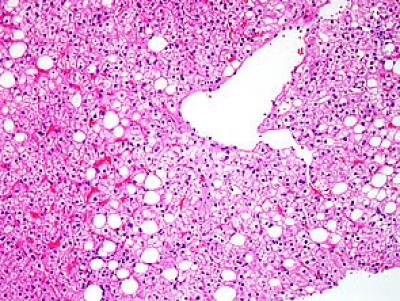
Two forms of nonalcoholic fatty liver disease (NAFLD) are depicted in these images of liver biopsies from adults, taken from this study.  The first shows nonalcoholic fatty liver only.
Elizabeth Brunt, M.D., of Washington University in Saint Louis.
The second shows nonalcoholic steatohepatitis (NASH), a more serious condition with potential to progress to cirrhosis.
Elizabeth Brunt, M.D., of Washington University in Saint Lou

People with nonalcoholic fatty liver disease (NALFD) who consume alcohol in modest amounts – no more than one or two servings per day – are half as likely to develop hepatitis as non-drinkers with the same condition, reports a national team of scientists led by researchers at the University of California, San Diego School of Medicine. The findings are published in the April 19, 2012 online issue ofThe Journal of Hepatology.
NALFD is the most common liver disease in the United States, affecting up to one third of American adults. It’s characterized by abnormal fat accumulation in the liver. The specific cause or causes is not known, though obesity and diabetes are risk factors. Most patients with NAFLD have few or no symptoms, but in its most progressive form, known as nonalcoholic steatohepatitis or NASH, there is a significantly heightened risk of cirrhosis, liver cancer and liver-related death.
NALFD is also a known risk factor for cardiovascular disease (CVD). Patients with NAFLD are approximately two times more likely to die from coronary heart disease than from liver disease. The study’s authors wanted to know if the well-documented heart-healthy benefits of modest alcohol consumption outweighed alcohol’s negative effects.
“We know a 50-year-old patient with NAFLD has a higher risk of CVD,” said Jeffrey Schwimmer, MD, associate professor of clinical pediatrics at UC San Diego, director of the Fatty Liver Clinic at Rady Children’s Hospital-San Diego and senior author. “Data would suggest modest alcohol consumption would be beneficial (in reducing the patient’s CVD risk) if you don’t take liver disease into account. When you do take liver disease into account, however, the usual medical recommendation is no alcohol whatsoever.”
Schwimmer and colleagues discovered that the benefits of modest alcohol consumption were compelling, at least in terms of reducing the odds of patients with NAFLD from developing more severe forms of the disease. Patients with NASH are 10 times more likely to progress to cirrhosis, the final phase of chronic liver disease. Cirrhosis is the 12th leading cause of death in the U.S., killing an estimated 27,000 Americans annually.
“Our study showed that those people with modest alcohol intake – two drinks or less daily – had half the odds of developing NASH than people who drank no alcohol,” said Schwimmer. “The reasons aren’t entirely clear. It’s known that alcohol can have beneficial effects on lipid levels, that it increases ‘good’ cholesterol, which tends to be low in NAFLD patients. Alcohol may improve insulin sensitivity, which has a role in NAFLD. And depending upon the type of alcohol, it may have anti-inflammatory effects.”
The study also found that in patients with NAFLD, modest drinkers experienced less severe liver scarring than did lifelong non-drinkers.
The study did not evaluate the effects of different types of alcohol, such as beer or spirits. Schwimmer said to do so would require a much larger study. Also, the study’s findings do not apply to children. All of the participants in the study were age 21 and older.
The current paper is based on analyses of 600 liver biopsies of patient’s with NAFLD by a national panel of pathologists who had no identifying clinical information about the samples. The study excluded anyone who averaged more than two alcoholic drinks per day or who reported consuming five or more drinks in a day (binge-drinking) at least once a month. All of the patients were at least 21 years of age.
Schwimmer said the findings indicate patients with liver disease should be treated individually, with nuance.
“For a patient with cirrhosis or viral hepatitis, the data says even small amounts of alcohol can be bad. But that may not be applicable to all forms of liver disease. Forty million Americans have NAFLD. Physicians need to look at their patient’s overall health, their CVD risk, their liver status, whether they’re already drinking modestly or not. They need to put all of these things into a framework to determine risk. I suspect modest alcohol consumption will be an appropriate recommendation for many patients, but clearly not all.”

CONTACTO · Aviso Legal · Política de Privacidad · Política de Cookies

Copyright © Noticia de Salud